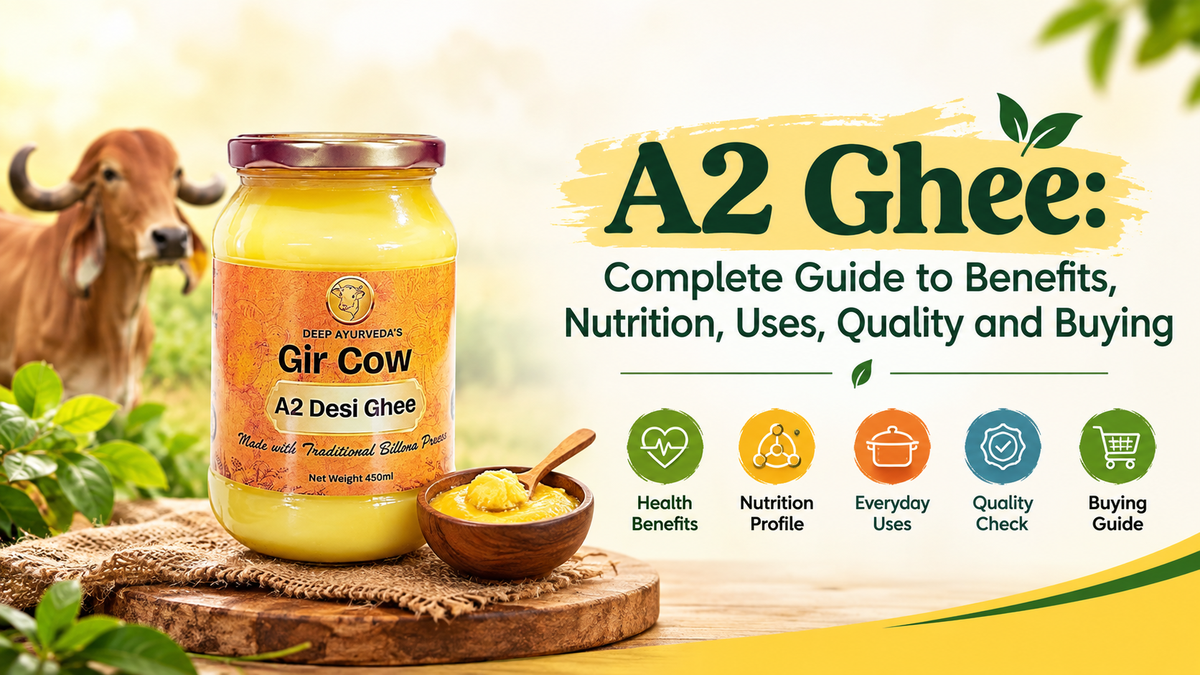
A2 ghee has become increasingly popular in India, especially among people looking for traditional cow ghee, Gir cow ghee and Bilona-made products. But there is a lot of confusion around what A2 actually means.
Is A2 ghee really different from regular cow ghee? Is every Gir cow an A2 cow? Does A2 protein remain in ghee? Is Bilona ghee automatically A2? And are the health benefits often mentioned online actually supported by scientific evidence?
The answers are more nuanced than many product pages suggest.
A2 refers to a type of beta-casein protein found in milk, whereas ghee is primarily milk fat. This distinction matters when evaluating claims about A2 ghee. India's food standards define ghee as clarified milk fat, with the specified standard requiring at least 99.5% milk fat.
This guide explains A2 ghee from the ground up—from the meaning of A2 and the role of Gir cows to nutrition, traditional preparation, potential benefits, quality checks and practical buying tips.
What Is A2 Ghee?
A2 ghee is generally marketed as ghee made from milk obtained from cows whose milk contains the A2 variant of beta-casein.
To understand this properly, it helps to separate three different things:
- A2 refers to a variant of beta-casein, a milk protein.
- Gir refers to a particular Indian cattle breed.
- Ghee is clarified milk fat.
These terms are related in some products, but they are not interchangeable.
What does A2 mean?
Cow's milk contains several proteins, including casein. Beta-casein is one of the major casein proteins, and naturally occurring genetic variants include A1 and A2 forms.
The difference between A1 and A2 beta-casein comes from a small genetic difference in the protein structure. During digestion, the two forms can behave differently.
This is why A2 milk has attracted scientific and consumer interest.
However, it is important not to take research conducted on A2 milk and automatically apply it to A2 ghee.
Milk contains water, proteins, carbohydrates, minerals and fat. Ghee is produced by separating and clarifying the fat portion. As a result, the composition of ghee is very different from the composition of milk.
Does A2 Protein Remain in Ghee?
This is one of the most important questions to ask before buying A2 ghee.
Ghee is primarily milk fat, not milk protein.
Under India's food standards, ghee has a minimum milk-fat requirement of 99.5%.
That means the A2 terminology associated with the original milk should not be interpreted as meaning that the finished ghee is a significant source of A2 beta-casein.
The basic process looks like this:
Cow → Milk → Butter/cream → Clarification → Ghee
A2 beta-casein is relevant to the milk stage. During ghee production, most non-fat milk components are separated from the fat.
This is why a scientifically careful article should distinguish between:
Research on A2 milk
and
Evidence specifically about A2 ghee
They are not the same thing.
A2 Cow Ghee vs A2 Gir Cow Ghee vs Regular Cow Ghee
The terminology used on ghee packaging can be confusing.
| Term | What it generally describes |
|---|---|
| A2 Ghee | Ghee marketed in connection with A2-type milk |
| A2 Cow Ghee | Cow-milk ghee marketed around A2 milk sourcing |
| A2 Gir Cow Ghee | Ghee marketed as being made from milk of Gir cows with A2-type milk |
| Cow Ghee | Ghee made from cow milk |
| Gir Cow Ghee | Ghee made from milk sourced from Gir cattle |
| Bilona Ghee | Ghee associated with a traditional preparation method |
The key point is that A2, Gir and Bilona describe different characteristics.
What is a Gir cow?
Gir is an indigenous cattle breed originating from the Gir region of Gujarat and surrounding areas.
Because many Indian indigenous cattle are associated with A2 beta-casein, the terms Gir cow and A2 cow are frequently used together in marketing.
But the terms should not simply be treated as synonyms.
Is every Gir cow automatically A2?
The safest approach is not to assume that a breed name alone proves the beta-casein genotype of an individual animal.
If a manufacturer makes a specific A2 claim, consumers should look for information about how the claim is established rather than relying solely on the breed name.
Is every desi cow automatically A2?
Again, desi cow describes indigenous Indian cattle, while A2 refers to a beta-casein variant.
Breed and protein genotype are related concepts in dairy genetics, but they are not the same definition.
How Is A2 Ghee Made?
The basic principle of making ghee is straightforward: milk fat is separated and heated until the product becomes clarified butterfat.
Traditional Indian ghee-making can involve several stages.
Milk → curdling/culturing → churning → butter → heating → clarification → ghee
The exact method can vary between producers.
What is the traditional Bilona method?
In the traditional Bilona process, milk is first cultured into curd. The curd is then churned to separate butter. The butter is subsequently heated and clarified to produce ghee.
This method is different from simply separating cream mechanically and converting it into butter and ghee.
Bilona is therefore a production method.
It is not the definition of A2.
Is Bilona ghee automatically A2?
No.
Bilona tells you how the ghee was produced. A2 refers to the beta-casein type associated with the milk.
A product can therefore be:
- Bilona without being marketed as A2
- A2-marketed without being made using a traditional Bilona process
- both Bilona and marketed as A2
- neither
This distinction is useful when comparing premium ghee products.
Does Bilona automatically make ghee healthier?
Not necessarily.
The production method can affect processing characteristics, flavour and traditional appeal, but the word Bilona by itself is not scientific proof that a ghee has a particular therapeutic effect.
A quality assessment should consider the whole product rather than relying on one marketing term.
A2 Ghee Nutrition: What Is Actually in It?
Ghee is an energy-dense food because it consists predominantly of fat.
Under India's food standards, ghee has a minimum milk-fat content of 99.5%.
Its nutritional profile therefore needs to be understood primarily in terms of dietary fat rather than protein.
Depending on the milk source, processing and analytical method, ghee can contain varying amounts of different fatty acids and small quantities of other fat-soluble components.
Does ghee contain protein?
Ghee is not considered a significant protein source.
Most of the milk proteins are separated during clarification.
Does ghee contain lactose?
Because ghee is primarily milk fat and most non-fat milk components are removed during production, it generally contains very little lactose compared with milk.
However, people with a medically diagnosed milk allergy should not assume that a dairy product is automatically suitable for them simply because it is ghee.
Does ghee contain A2 beta-casein?
The important distinction is that beta-casein is a milk protein, while ghee is overwhelmingly milk fat.
Therefore, an A2 claim associated with the source milk should not be interpreted as making ghee nutritionally equivalent to A2 milk.
A2 Ghee Benefits: What Does Science Actually Say?
A2 ghee is often promoted with a long list of health benefits, including better digestion, improved immunity, weight management, heart health and more.
A responsible health article needs to separate established nutritional facts from claims that have not been adequately demonstrated.
1. A2 milk and digestive comfort
There is some human research investigating whether milk containing only A2 beta-casein may be tolerated differently from milk containing both A1 and A2 beta-casein.
For example, a 2024 randomized, double-blind crossover study involving 40 adults who reported digestive discomfort after drinking milk found that A2 milk produced less abdominal pain, urgency and borborygmus on some measures. However, the same study also found more bloating and loose stools on certain measures.
This is important because it shows that the evidence is not as simple as saying:
A2 milk is always easier to digest.
A review of the evidence has also noted that research into the health effects of A2 milk remains limited and that stronger clinical evidence is still needed.
More importantly, these studies investigated A2 milk—not A2 ghee.
Therefore, they should not be presented as clinical proof that A2 ghee improves digestion.
2. Ghee as a source of dietary fat
Ghee can provide energy and fat as part of a balanced diet.
Because it is highly concentrated in fat, a small amount can add considerable calories to a meal.
For this reason, ghee can be used as a cooking fat or flavouring ingredient without needing to be treated as a medicinal food.
3. Fat-soluble components
Milk fat contains fat-soluble compounds, including vitamins and other minor components. Their amounts can vary depending on factors such as the animal's diet, milk composition and processing.
This does not mean that eating larger amounts of ghee automatically provides greater health benefits.
4. Traditional use of ghee
Ghee has a long history in Indian cooking and traditional food practices, including Ayurveda.
Traditional use can be discussed as part of India's culinary and cultural heritage, but traditional use should not automatically be presented as clinical proof that ghee can prevent or treat a disease.
What A2 Ghee Has Not Been Proven to Do
This is an important section because health-related ghee content often makes claims much stronger than the evidence allows.
There is not sufficient evidence to describe A2 ghee as a proven treatment for:
- obesity
- diabetes
- heart disease
- digestive disorders
- joint disease
- inflammation
- immunity problems
- hormonal disorders
Similarly, research on A2 milk should not be used as proof that A2 ghee can prevent or cure these conditions.
The more accurate approach is to evaluate ghee primarily as a traditional dairy fat and food ingredient.
A2 Ghee vs Regular Cow Ghee: What's the Difference?
The most meaningful difference depends on the source of the milk and the production process, rather than simply the word A2 on the label.
| Factor | A2-marketed cow ghee | Regular cow ghee |
|---|---|---|
| Source | Usually marketed around A2 milk | Cow milk |
| A2 terminology | Used in product positioning | May not be mentioned |
| Main component | Milk fat | Milk fat |
| Protein content | Very low | Very low |
| Production | Can vary | Can vary |
| Bilona | May or may not be used | May or may not be used |
| Quality | Depends on product and processing | Depends on product and processing |
Is A2 ghee automatically healthier than regular ghee?
There is not enough evidence to make a blanket statement that every A2-marketed ghee is healthier than every regular cow ghee.
If two products are both genuine, properly made ghee, the overall nutritional profile is primarily that of milk fat.
The better buying question is therefore not simply:
Does the label say A2?
It is:
What is the source, how was it produced, and what evidence does the manufacturer provide about the product's quality?
A2 Gir Cow Ghee: What Makes Gir Milk Different?
Gir cattle are an important indigenous Indian breed, and Gir cow products have become popular in the premium dairy market.
However, three concepts should remain separate:
Gir = breed
A2 = beta-casein variant
Ghee = clarified milk fat
A product described as A2 Gir Cow Ghee is combining these concepts in its product description.
That does not mean that Gir, A2 and ghee all describe the same characteristic.
Why do brands emphasize Gir cows?
Gir cattle have a strong association with India's indigenous dairy heritage, and consumers often seek products made from milk of indigenous breeds.
For buyers interested in provenance, information about the breed, farming practices, milk collection and processing can therefore be useful.
But breed claims should ideally be supported by transparent sourcing information rather than treated as a substitute for product testing.
How to Choose Good Quality A2 Ghee
If you are buying ghee, quality and authenticity deserve more attention than attractive health claims.
Here is a practical checklist.
1. Read the ingredient information
Look for a straightforward ingredient declaration appropriate to the product.
Be cautious about products whose marketing is extensive but whose basic product information is difficult to find.
2. Check the manufacturer
Look for:
- manufacturer/packer details
- batch information
- net quantity
- date information
- customer-care details
- relevant food-business information
3. Look for transparent sourcing information
If the product claims to be made from Gir cow milk or milk from a particular indigenous breed, see whether the manufacturer explains its sourcing practices.
The more specific the claim, the more useful supporting information becomes.
4. Understand laboratory reports
A laboratory report can be useful, but do not stop at a badge saying lab tested.
Ask:
- What was tested?
- When was it tested?
- Which batch was tested?
- What parameters were measured?
- What were the actual results?
A purity test and an A2 genetic claim are not necessarily the same test.
5. Don't assume Bilona proves purity
Bilona describes a preparation method.
It does not, by itself, prove that a product is free from adulteration or establish the beta-casein genotype of the original animal.
6. Don't judge purity only by colour
Ghee colour can vary due to milk composition, animal diet, processing and other factors.
A particular shade of yellow is not, by itself, a reliable laboratory test of purity.
Can You Identify Pure Ghee at Home?
People often see viral home tests involving heating, refrigeration, colour, smell or texture.
Some sensory observations can help you assess whether a product looks and smells typical, but these methods have important limitations.
You can observe:
- aroma
- flavour
- texture
- appearance
- melting behaviour
- storage stability
But these observations cannot establish the genetic A2 status of the milk source.
They also cannot replace proper laboratory analysis for determining specific adulterants or compositional parameters.
So, if a product is marketed as premium A2 Gir cow ghee, don't rely solely on a viral home purity test to verify the claim.
How Much Ghee Should You Eat in a Day?
There is no universal number of teaspoons that is appropriate for every person.
The amount of ghee you consume should fit within your overall dietary pattern and total energy and fat intake.
For example, someone who already consumes substantial amounts of butter, cream, fried foods and other added fats may need a different amount of ghee than someone whose diet is otherwise low in added fats.
Is one teaspoon of ghee okay?
For many people, a small serving can be incorporated into a balanced diet, but the appropriate amount depends on the person's overall dietary needs.
The key point is that more ghee does not automatically mean more health benefits.
Ghee is calorie-dense, so portion size matters.
People following a medically prescribed diet should follow advice from their qualified healthcare professional or dietitian.
How to Use A2 Ghee in Indian Cooking
One reason ghee remains popular is its versatility in Indian food.
You can use ghee in:
- dal tadka
- khichdi
- rice
- roti
- paratha
- halwa
- traditional sweets
- roasting and sautéing
- finishing dishes for flavour
A small amount can provide a rich aroma and mouthfeel.
Rather than thinking of A2 ghee as a medicine, it is more useful to view it as a traditional cooking fat that can be used thoughtfully within an overall balanced diet.
How Should Ghee Be Stored?
Ghee is relatively stable because it contains very little water compared with milk or butter.
For good quality:
- keep the container tightly closed
- use a clean, dry spoon
- avoid introducing water into the container
- protect it from excessive heat and direct sunlight
- follow the manufacturer's storage instructions
- check the product's best-before information
If the aroma, flavour or appearance changes noticeably, investigate the product condition rather than assuming that every change is normal.
Is A2 Ghee Suitable for Everyone?
A2 should not be treated as a guarantee that a dairy product is suitable for every person.
People can have different responses to dairy products because of factors such as lactose digestion, milk-protein allergy and individual dietary requirements.
A2 milk research is also not the same as research on ghee.
For example, studies investigating A2 milk have specifically examined beta-casein-containing milk. Ghee has a substantially different composition because it is primarily milk fat.
Anyone with a diagnosed food allergy, digestive disorder or medically restricted diet should discuss dairy intake with an appropriate healthcare professional.
A2 Ghee Myths vs Facts
Myth: A2 means the ghee contains lots of A2 protein.
Fact: A2 refers to a beta-casein variant in milk. Ghee is primarily milk fat, so the A2 milk-protein concept should not be interpreted as meaning ghee is a significant source of A2 beta-casein.
Myth: Every Gir cow automatically means A2.
Fact: Gir is a cattle breed, while A2 describes a beta-casein variant. They should not be treated as identical terms.
Myth: Bilona means A2.
Fact: Bilona describes a traditional preparation method. It does not define the beta-casein genotype of the milk.
Myth: A2 ghee is proven to help with weight loss.
Fact: There is no good basis for presenting A2 ghee as a proven weight-loss food.
Myth: A2 ghee is a treatment for digestive problems.
Fact: Some human studies have investigated digestive responses to A2 milk, but that evidence cannot automatically be transferred to A2 ghee.
Myth: Golden-yellow colour proves that ghee is pure.
Fact: Colour alone cannot establish purity or authenticity.
Myth: A home test can prove that ghee is A2.
Fact: Sensory or household tests cannot establish the beta-casein genotype of the cow from which the milk originated.
5 Things Most Buyers Don't Know
1. A2 describes a protein, not a special type of fat
A2 refers to beta-casein in milk. Ghee is predominantly milk fat.
2. Gir and A2 are not synonyms
Gir identifies a cattle breed. A2 identifies a beta-casein variant.
3. Bilona and A2 describe different things
Bilona is a production method; A2 relates to milk protein genetics.
4. A2 milk research is not automatically A2 ghee research
Human trials investigating A2 milk should not be presented as direct clinical trials of A2 ghee.
5. Quality matters beyond the label
Source transparency, manufacturing information, food-safety compliance and appropriate testing are more useful indicators than a single marketing word.
Final Thoughts
A2, Gir and ghee describe three different things: A2 refers to a milk-protein variant, Gir is a cattle breed, and ghee is clarified milk fat.
While some research has explored potential differences between A2 and conventional milk, those findings should not automatically be applied to A2 ghee. For buyers, focus on quality, sourcing, production method, transparency and food-safety information rather than health claims alone.
Enjoy ghee as part of a balanced diet, and treat A2 as a product characteristic—not a guarantee of special health benefits.
Frequently Asked Questions About A2 Ghee
What is A2 ghee?
A2 ghee is generally marketed as ghee made from milk associated with cows producing the A2 variant of beta-casein. However, A2 refers to a milk protein, while ghee is primarily milk fat.
What is A2 cow ghee?
A2 cow ghee is cow-milk ghee marketed using an A2 milk-source claim. The exact sourcing and production method can vary between manufacturers.
What is A2 Gir cow ghee?
A2 Gir cow ghee is generally marketed as ghee made from milk sourced from Gir cattle and associated with A2 beta-casein. Gir refers to the breed, while A2 refers to a beta-casein variant.
Is all Gir cow ghee A2?
The terms should not be treated as automatic synonyms. If a manufacturer makes a specific A2 claim, consumers should look for transparent evidence supporting that claim.
Is A2 ghee better than regular ghee?
There is not enough evidence to make a blanket statement that A2-marketed ghee is healthier than all regular cow ghee. Ghee is primarily milk fat, so product quality, source and overall dietary context matter.
Is Bilona ghee the same as A2 ghee?
No. Bilona describes a traditional method of preparing ghee, while A2 refers to a beta-casein variant associated with the source milk.
Does A2 ghee contain A2 protein?
Ghee is predominantly milk fat and contains very little protein compared with milk. Therefore, the A2 designation should not be interpreted as meaning that ghee is a major source of A2 beta-casein.
Is A2 ghee easier to digest?
Evidence about digestive comfort has primarily studied A2 milk. Some human studies have found differences in gastrointestinal symptoms between A2 milk and conventional A1/A2 milk, but this does not establish the same effect for ghee.
Does A2 ghee contain lactose?
Ghee contains very little of the non-fat components found in milk because it is primarily clarified milk fat. However, people with milk allergies should not assume that ghee is automatically suitable for them.
How can I check whether ghee is pure?
Start with the label, manufacturer information, ingredient declaration, batch details and any meaningful laboratory testing provided by the manufacturer. Home sensory tests can provide observations but cannot replace laboratory analysis.
How much A2 ghee should I eat daily?
There is no universal amount suitable for everyone. Ghee is calorie-dense, so the appropriate quantity depends on your overall diet, energy needs and total fat intake.
Can I cook with A2 ghee every day?
Ghee can be used as a cooking fat as part of a balanced diet. The important consideration is the overall amount of added fat in your diet rather than assuming that a particular ghee can be consumed without limits.
How should ghee be stored?
Keep ghee tightly closed, use a clean and dry spoon, protect it from excessive heat and moisture, and follow the storage instructions on the package.