
Manjistha powder is a traditional Ayurvedic herbal preparation made from the roots of Rubia cordifolia, commonly known as Indian madder. It is traditionally used in Ayurveda, particularly in discussions about skin health and overall well-being. Today, many people are interested in Manjistha powder because they want to understand its potential benefits, how to use it, and what precautions to follow.
However, it is important to distinguish traditional Ayurvedic uses from benefits that have been confirmed through high-quality human studies. Research on Rubia cordifolia has explored various biological activities, but findings from laboratory experiments and animal studies do not automatically prove that Manjistha powder produces the same effects in people.
In this guide, you will learn what Manjistha powder is, its traditional uses, what scientific research tells us, how to approach its use safely, and what to check before choosing a product.
What Is Manjistha Powder?
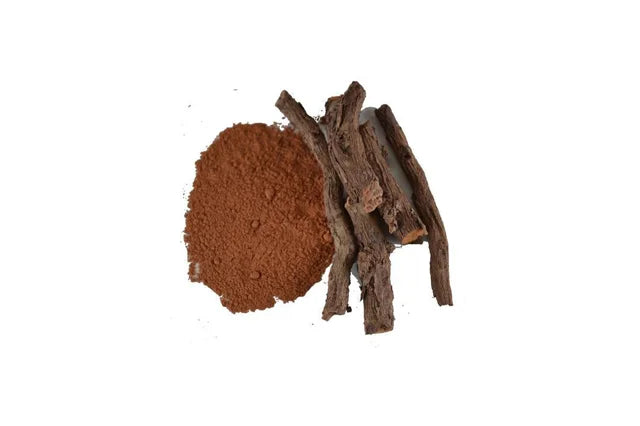
Manjistha powder is a herbal powder commonly prepared from the roots of Rubia cordifolia, a plant used in traditional Ayurvedic practice. The plant is also known as Indian madder and is recognized for its naturally occurring red-coloured compounds.
In Ayurveda, Manjistha has traditionally been associated with skin health and concepts relating to rakta (blood) and rakta dhatu within the traditional Ayurvedic framework. These concepts belong to Ayurveda's own system of understanding the body and should not automatically be interpreted as equivalent to modern medical findings about blood function.
Manjistha products are available in different forms, including:
- Root powder
- Capsules containing herbal powder
- Standardized or concentrated extracts
- Formulations combining Manjistha with other herbs
These preparations may differ in composition and concentration. Therefore, research involving a concentrated extract cannot automatically be applied to every Manjistha powder available in the market.
What Are the Potential Benefits of Manjistha Powder?
Manjistha has a long history of traditional use, but the scientific evidence for its individual health benefits varies. The following sections explain common areas of interest while distinguishing traditional practices from established clinical evidence.
1. Traditional Use for Skin Health
Skin health is one of the most common reasons people explore Manjistha powder. In Ayurveda, it has traditionally been used in preparations intended to support skin care.
Some people use Manjistha externally as part of a homemade herbal face pack. However, there is not enough high-quality human evidence to establish that Manjistha powder reliably treats acne, pigmentation, dark spots, or other skin conditions.
If you are considering a topical preparation, use a small patch test first. Avoid applying it to broken or irritated skin, and stop immediately if you notice redness, itching, burning, or swelling. Persistent acne or pigmentation may require advice from a dermatologist rather than relying on a herbal preparation alone.
2. Antioxidant Activity: What Research Suggests
Rubia cordifolia contains naturally occurring compounds that researchers have investigated for antioxidant activity. Antioxidants are substances that can help counter certain chemical reactions involving free radicals under particular conditions.
Laboratory findings may help researchers understand how plant compounds behave, but they do not establish that taking Manjistha powder prevents disease or produces a measurable health benefit in humans.
The effects of a herbal preparation also depend on its composition, processing, concentration, and the amount used. More clinical research is needed before specific antioxidant-related health claims can be made confidently.
3. Anti-Inflammatory Research
Some laboratory and animal studies have investigated the anti-inflammatory properties of compounds found in Rubia cordifolia. These findings are scientifically interesting, but they should not be interpreted as proof that Manjistha powder treats inflammation-related diseases in people.
A plant extract studied under controlled experimental conditions may differ considerably from an ordinary commercial powder. Human studies are needed to establish whether a particular preparation is effective, at what dose, and with what risks.
4. Other Traditional Ayurvedic Uses
Manjistha is discussed in traditional Ayurvedic practice in connection with several aspects of health and well-being. Its use may vary according to the formulation, individual circumstances, and the practitioner's assessment.
It is important not to interpret traditional terms such as “blood purifier” or “detoxification” as proof that Manjistha removes toxins from the blood or improves liver or kidney function. These claims require appropriate clinical evidence.
Health Expert note: Traditional use can provide a starting point for research, but it is not the same as demonstrated medical effectiveness. Manjistha powder should not replace prescribed treatment for a diagnosed condition.
How to Use Manjistha Powder Safely
The appropriate way to use Manjistha powder depends on the product, its intended use, and your individual health circumstances. There is no single method or dose that can be recommended for everyone.
1. Oral Use of Manjistha Powder
Some Ayurvedic preparations are intended to be taken orally. If you are considering this form, check the product label and consult a qualified Ayurvedic practitioner or healthcare professional to determine whether it is appropriate for you.
Keep these points in mind:
Use only a product clearly labelled for oral use.
Follow the directions for that specific preparation.
Do not increase the amount in an attempt to obtain faster results.
Check with a healthcare professional if you take regular medication or have an existing medical condition.
Do not use Manjistha powder as a substitute for prescribed medicines.
Not every product labelled Manjistha is intended for the same purpose. A powder designed for external application should not be consumed.
2. Can You Mix Manjistha Powder With Water or Honey?
Water and honey are sometimes used as vehicles for traditional herbal preparations. However, there is insufficient evidence to show that mixing Manjistha powder with either ingredient makes it more effective.
If you are considering oral use, follow the instructions for your specific product and seek professional guidance when needed. Honey is not suitable for infants under 12 months, and people who need to manage their blood glucose should consider its sugar content.
3. How to Use Manjistha Powder as a Face Pack
Manjistha powder is sometimes included in homemade face packs as part of traditional herbal skin care. However, homemade preparations have not been established as reliable treatments for acne, pigmentation, or other skin conditions.
If you choose to try an external preparation:
1. Check that the product is intended for topical use.
2. Follow the manufacturer's instructions for preparation.
3. Test a small amount on an area of skin first and observe for a reaction.
4. Keep the preparation away from your eyes, lips, broken skin, and irritated areas.
5. Stop using it if you experience burning, itching, redness, or swelling.
A patch test can help identify some reactions, but it cannot guarantee that a product will never cause irritation or an allergic response.
If you have persistent acne, painful lesions, or pigmentation that is changing or worsening, consult a dermatologist instead of relying on a homemade face pack.
4. Can Manjistha Powder Be Combined With Other Herbs?
Some Ayurvedic formulations combine Manjistha with other ingredients. These combinations may have different effects and risks from those of a single-herb powder.
Before combining herbal products, check the complete ingredient list and seek professional advice, especially if you take prescription medicines, are pregnant or breastfeeding, or have an existing health condition.
What Is the Right Dosage of Manjistha Powder?
There is no universally established, evidence-based dose of Manjistha powder that is appropriate for every person and every preparation.
The amount may depend on the product's composition, concentration, intended use, and the individual's circumstances. A concentrated extract and a whole-root powder are not interchangeable on a gram-for-gram basis.
Before using Manjistha powder, consider the following:
Check the product instructions: Use the directions supplied for the exact preparation you have.
Avoid guessing measurements: A household teaspoon does not provide a consistent weight for every powder.
Do not take more than directed: A higher amount has not been shown to guarantee better results.
Seek individual advice: A qualified professional can help assess whether the preparation is suitable for you.
Children, pregnant or breastfeeding individuals, and people taking regular medication should not begin medicinal use without appropriate professional advice.
Be cautious of websites that recommend a fixed daily dose or promise results within a particular number of days without reliable evidence for the specific preparation.
What Are the Side Effects of Manjistha Powder?
The safety of Manjistha powder has not been adequately established for every formulation, dose, or duration of use. Limited human evidence means that the absence of reported problems should not be taken as proof that a product is safe for everyone.
Possible concerns include:
Skin irritation or an allergic reaction when applied externally.
Individual intolerance to an orally consumed preparation.
Uncertain interactions with medicines or other herbal products.
Risks associated with poor-quality, contaminated, incorrectly identified, or adulterated products.
These are safety considerations, not a claim that every effect listed has been definitively established as a specific adverse effect of Manjistha in human studies.
Who Should Be Especially Careful?
Pregnant or breastfeeding individuals: Reliable safety information is limited. Avoid self-prescribing Manjistha medicinal preparations and consult a qualified healthcare professional before use.
People taking prescription medicines: Discuss potential interactions with a pharmacist or treating clinician before starting a herbal product.
People with existing health conditions: Seek individual advice rather than assuming a traditional herb is automatically safe.
People with sensitive skin: Take particular care with topical products, and discontinue use if irritation develops.
When Should You Stop Using Manjistha Powder?
Stop using an external preparation if you develop a rash, itching, burning, or swelling. Seek medical advice if symptoms persist or worsen.
If you experience difficulty breathing or swelling of the face, tongue, or throat after using any product, seek emergency medical care immediately.
Do not delay medical assessment of a health problem in the hope that Manjistha powder will resolve it.
How to Choose Good-Quality Manjistha Powder
Choosing a suitable herbal product is important because the name on the front of the package alone does not establish its identity, purity, or safety.
Before purchasing Manjistha powder, use the following checklist.
1. Check the Botanical Name
Look for Rubia cordifolia on the ingredient label. This helps identify the intended plant, although a label alone cannot independently verify the contents.
2. Read the Full Ingredient List
Check whether the product contains only Manjistha root powder, a concentrated extract, or a combination of several herbs. These preparations are different and should not be assumed to have the same composition or effects.
3. Check Manufacturer and Batch Details
Look for the manufacturer's name and contact information, batch or lot number, manufacturing and expiry dates, and applicable regulatory details.
4. Look for Credible Quality Testing
Where available, review relevant testing documentation for identity, microbial contamination, heavy metals, and other contaminants appropriate to the product. Do not assume that a quality claim has been independently verified unless supporting documentation is available.
5. Review Packaging and Storage Instructions
Choose a properly sealed product with clear storage directions. Avoid products with damaged packaging, missing labels, or unclear expiry information.
6. Be Careful With Exaggerated Health Claims
Avoid products or websites promising guaranteed skin whitening, complete acne removal, blood purification, detoxification, or cures for diseases.
Remember: Colour, smell, price, and online reviews alone cannot establish the purity or effectiveness of a herbal powder.
What Does Scientific Research Actually Say About Manjistha?
Scientific research on Rubia cordifolia has investigated its naturally occurring compounds and potential biological activities. Some findings from laboratory and animal studies have encouraged further research, but the evidence needs to be interpreted carefully.
There are three important distinctions:
|
Type of evidence |
What it can tell us |
|
Traditional Ayurvedic use |
How a plant has historically been used within a traditional medical system |
|
Laboratory and animal studies |
How plant compounds behave under specific experimental conditions |
|
Human clinical studies |
Whether a particular preparation produces meaningful benefits or harms in people |
Evidence from one category cannot automatically establish a conclusion in another.
For example, a compound showing antioxidant activity in a laboratory does not prove that consuming Manjistha powder improves skin health or prevents disease. Similarly, findings from a concentrated extract may not apply to an unstandardized powder.
Before a health benefit can be confidently recommended, researchers need appropriate human studies that assess the specific preparation, dose, outcomes, and potential adverse effects.
For readers, the practical takeaway is simple: Manjistha has a history of traditional use and is a subject of scientific investigation, but many commonly advertised health benefits still require better clinical evidence.
Conclusion
Manjistha powder is a traditional Ayurvedic herbal preparation made from Rubia cordifolia, best known for its traditional association with skin health. Although scientific research has explored its plant compounds and potential biological activities, many commonly claimed health benefits have not yet been firmly established through high-quality human studies.
If you are considering using Manjistha powder, choose a clearly labelled product, understand whether it is intended for oral or external use, follow product-specific directions, and seek professional advice when appropriate. Pay particular attention to safety if you take medicines, have an existing health condition, or are pregnant or breastfeeding.
Most importantly, do not rely on Manjistha powder as a replacement for evidence-based medical care. A well-informed decision should consider traditional use, the strength of available scientific evidence, product quality, and your individual health needs.
Health information note: This article is for educational purposes and is not a substitute for individual medical advice. It should be reviewed by a qualified healthcare professional before publication.
Frequently Asked Questions About Manjistha Powder
1. What are the benefits of Manjistha powder?
Manjistha powder is traditionally used in Ayurveda, particularly in preparations associated with skin health. Research has investigated compounds in Rubia cordifolia, but strong human evidence confirming many advertised benefits remains limited.
2. How should Manjistha powder be used?
The appropriate method depends on whether the preparation is intended for oral or external use. Follow the instructions for the specific product and seek professional advice before medicinal use. Never consume a product intended only for topical application.
3. What is the recommended dosage of Manjistha powder?
There is no universally established dose suitable for every Manjistha preparation and individual. Follow the product-specific instructions and consult a qualified professional rather than relying on a generic online dosage.
4. Can Manjistha powder help with acne and other skin problems?
Manjistha has traditional uses in Ayurvedic skin care, but there is insufficient high-quality human evidence to establish that it reliably treats acne or pigmentation. Persistent or severe skin problems should be assessed by a dermatologist.
5. What are the possible side effects of Manjistha powder?
Safety data are limited. Possible concerns include skin irritation, individual intolerance, product contamination, and uncertain interactions with medicines. Stop use if a reaction occurs and seek medical advice when necessary.
6. Can Manjistha powder be taken every day?
Daily use should not be assumed safe for everyone, particularly because long-term human safety data are limited. Ask a qualified healthcare professional whether a specific preparation is suitable for your circumstances.
7. Is Manjistha powder safe during pregnancy and breastfeeding?
Reliable safety evidence is insufficient to establish that medicinal use is safe during pregnancy or breastfeeding. Avoid self-medication and consult your healthcare professional before using it.
8. How long does it take for Manjistha powder to show results?
There is no reliable, universally established timeline for results. Effects may differ depending on the preparation and intended use, and many claimed benefits have not been adequately demonstrated in human studies. Be cautious of products promising guaranteed results within a fixed number of days.