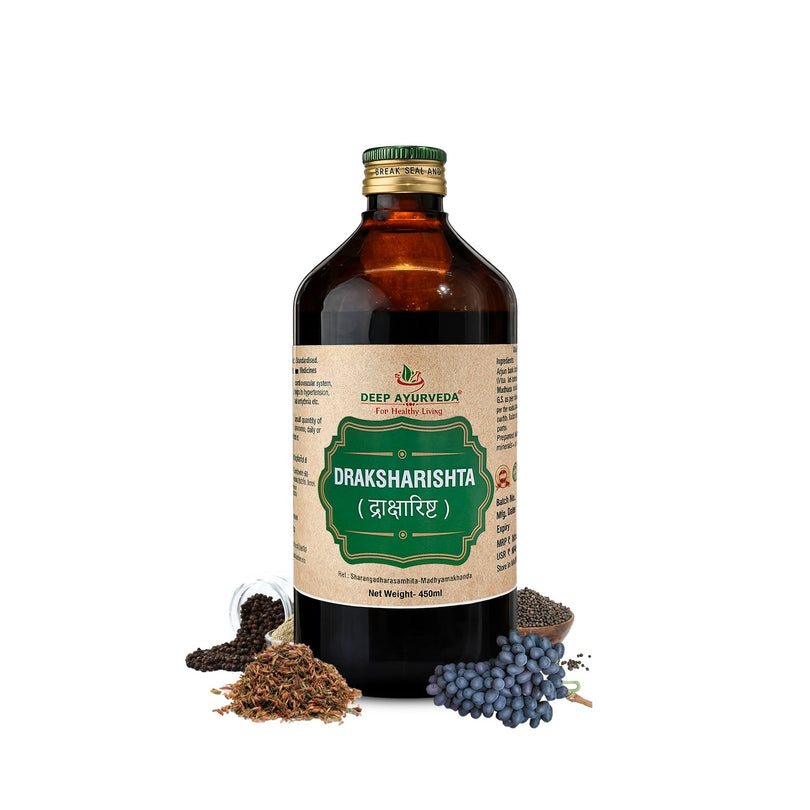
Deep Ayurveda Draksharishta
✅ Supports Healthy Digestion ✅ Boosts Energy and Stamina ✅ Supports Respiratory Wellness ✅ Supports Natural Recovery ✅ Supports Liver Health
Draksharishta is a classical Ayurvedic fermented formulation (Arishta) prepared primarily from Draksha (grapes) along with several traditional herbs. In Ayurveda, it is traditionally used to support healthy digestion, improve appetite, promote strength, and assist overall well-being. Its naturally fermented preparation enhances shelf life and is believed to aid the bioavailability of herbal constituents.
Like any Ayurvedic medicine, Draksharishta should be taken under the guidance of a qualified Ayurvedic practitioner, especially for children, older adults, pregnant or breastfeeding women, or individuals with underlying medical conditions.
Quick Facts About Draksharishta
|
Feature |
Details |
|
Classical Formulation |
Arishta (Fermented Ayurvedic Preparation) |
|
Primary Ingredient |
Draksha (Grapes) |
|
System of Medicine |
Ayurveda |
|
Dosage Form |
Liquid |
|
Traditional Taste |
Sweet with mildly fermented notes |
|
Common Use in Ayurveda |
Digestive support, appetite, nourishment, general wellness |
|
Best Taken |
As advised by an Ayurvedic practitioner |
|
Suitable For |
Adults (unless otherwise prescribed) |
Introduction
Ayurveda has relied on fermented herbal formulations for centuries to support health in a holistic manner. Among these traditional preparations, Draksharishta is one of the well-known classical formulations, valued for its nourishing and digestive-supporting properties.
Prepared mainly from Draksha (grapes) and a carefully selected blend of Ayurvedic herbs, Draksharishta undergoes a natural fermentation process that develops its characteristic properties. Unlike synthetic formulations, this traditional method has been described in Ayurvedic literature and continues to be used in clinical practice today.
In my experience as an Ayurvedic practitioner, many people are familiar with the name Draksharishta but are often unsure about what it contains, how it works from an Ayurvedic perspective, who may benefit from it, and how it should be used responsibly. These are also some of the most common questions patients ask during consultations.
This comprehensive guide explores Draksharishta through both classical Ayurvedic principles and modern understanding, helping you make informed decisions while appreciating the traditional wisdom behind this formulation. We'll discuss its ingredients, traditional uses, dosage guidance, precautions, and practical considerations in a balanced and evidence-informed way.
If you're interested in learning about another classical fermented Ayurvedic formulation, you may also enjoy our detailed guide on Ashwagandharishta, which explains its ingredients, traditional uses, dosage, and Ayurvedic perspective.
What is Draksharishta?
Draksharishta is a classical Ayurvedic fermented herbal formulation (Arishta) prepared primarily from Draksha (Vitis vinifera Linn.), commonly known as grapes. It is formulated using a combination of herbs that undergo natural fermentation, creating a self-preserving liquid preparation that has been used in Ayurveda for centuries.
Unlike modern syrups or herbal tonics, Draksharishta is prepared according to traditional Ayurvedic pharmaceutical methods described in classical texts. During the fermentation process, naturally occurring microorganisms convert a small amount of sugar into self-generated alcohol. This natural process not only helps preserve the formulation but is also traditionally believed to improve the extraction and assimilation of herbal constituents.
In Ayurveda, Draksharishta is traditionally valued for supporting Agni (digestive fire), nourishing the body's tissues (Dhatus), and promoting overall vitality. Rather than targeting a single symptom, it is understood as a formulation that helps restore balance according to Ayurvedic principles.
As an Ayurvedic doctor, I often explain to patients that Draksharishta should not be viewed as a quick remedy. Instead, it is traditionally used as part of a personalised Ayurvedic approach that considers an individual's Prakriti (constitution), Vikriti (current imbalance), digestive capacity, lifestyle, and dietary habits.
Historical Background of Draksharishta
The use of fermented herbal preparations has been an integral part of Ayurveda for thousands of years. Formulations such as Arishta and Asava were developed to preserve medicinal herbs naturally while enhancing their therapeutic potential through controlled fermentation.
Draksharishta has long been used in Ayurvedic practice as a nourishing formulation prepared from grapes and complementary herbs. Grapes are traditionally described in Ayurveda as Madhura (sweet) in taste and are valued for their nourishing, refreshing, and balancing qualities when used appropriately.
The classical preparation method reflects Ayurveda's holistic philosophy, where the selection of ingredients is based on their combined action rather than the effect of a single herb. This synergistic approach remains one of the defining characteristics of traditional Ayurvedic formulations.
Classical Ayurvedic Perspective
In Ayurveda, health depends on the harmonious balance of the three Doshas—Vata, Pitta, and Kapha—along with proper digestion, healthy tissue formation, efficient waste elimination, and a calm state of mind.
Draksharishta is traditionally used with the intention of supporting these fundamental principles. Ayurvedic practitioners may recommend it in situations where there is diminished digestive strength (Mandagni) or when nourishment and vitality need support, always after assessing the individual's constitution and health status.
From an Ayurvedic perspective, Draksharishta is traditionally appreciated for its potential to:
- Support healthy digestive function (Agni).
- Promote proper nourishment of body tissues (Dhatus).
- Encourage balanced metabolism.
- Assist in maintaining overall strength and vitality.
- Complement a holistic lifestyle that includes appropriate diet and daily routine.
It is important to note that Ayurvedic formulations are selected based on the individual's overall assessment rather than on symptoms alone.
What Makes Draksharishta Different from Other Ayurvedic Formulations?
One of the most common questions patients ask is, Why choose Draksharishta instead of another Ayurvedic tonic?
The answer lies in its classical composition and method of preparation.
Unlike single-herb products, Draksharishta combines multiple herbs that work together according to Ayurvedic principles. The natural fermentation process is another distinguishing feature, as it helps create a stable liquid formulation that has traditionally been considered easy to consume and assimilate.
Another unique aspect is its emphasis on Draksha (grapes), an ingredient traditionally regarded for its nourishing qualities. Combined with aromatic spices and supportive herbs, the formulation reflects Ayurveda's concept of using complementary ingredients to achieve balance rather than relying on one dominant herb.
How is Draksharishta Prepared?
The preparation of Draksharishta follows a carefully designed classical process that has been practiced in Ayurveda for generations.
Although manufacturing methods may vary slightly among licensed Ayurvedic manufacturers, the traditional preparation generally involves the following steps:
Step 1: Selection of Raw Herbs
High-quality herbs are selected and cleaned to remove impurities. The quality of raw materials plays a significant role in the final formulation.
Step 2: Preparation of Herbal Decoction
The prescribed herbs are boiled in water under controlled conditions to obtain a concentrated herbal extract.
Step 3: Addition of Sweetening Agents
Traditionally, ingredients such as jaggery or sugar are added in specified proportions. These provide the substrate required for natural fermentation.
Step 4: Natural Fermentation
The mixture is transferred to fermentation vessels, where naturally occurring microorganisms initiate fermentation over a controlled period. This process produces a small amount of naturally occurring alcohol that acts as a preservative.
Step 5: Filtration and Maturation
After fermentation is complete, the formulation is filtered, matured, and quality-checked before packaging.
This traditional pharmaceutical process distinguishes Draksharishta from ordinary herbal syrups and reflects the sophisticated methods described in Ayurvedic pharmaceutics.
Key Ingredients in Draksharishta
The exact composition may vary slightly depending on the classical reference followed by the manufacturer, but the formulation is primarily centred around Draksha (grapes) along with supporting Ayurvedic herbs.
Below are some commonly used ingredients and their traditional Ayurvedic roles.
|
Ingredient |
Botanical Name |
Traditional Ayurvedic Role |
|
Draksha |
Vitis vinifera |
Nourishing, supports digestion and overall vitality |
|
Dhataki |
Woodfordia fruticosa |
Traditionally used to support the natural fermentation process |
|
Pippali |
Piper longum |
Supports digestive fire (Agni) and the assimilation of herbs |
|
Maricha |
Piper nigrum |
Traditionally used to aid digestion and metabolic function |
|
Twak (Cinnamon) |
Cinnamomum verum |
Adds aromatic qualities and traditionally supports digestion |
|
Ela (Cardamom) |
Elettaria cardamomum |
Traditionally valued for digestive comfort and pleasant aroma |
|
Nagakesara (where applicable) |
Mesua ferrea |
Traditionally included in some classical formulations for balancing properties |
Note: Ingredient lists can vary depending on the classical reference and the licensed manufacturer. Always refer to the product label for the exact composition.
How Do These Ingredients Work Together?
One of the strengths of Ayurveda lies in its emphasis on synergy rather than isolated compounds.
In Draksharishta, grapes provide the nourishing foundation of the formulation, while herbs such as Pippali, Maricha, and aromatic spices are traditionally included to support digestive function and the proper utilisation of nutrients. Dhataki flowers play a key role in facilitating the natural fermentation process.
This combination reflects Ayurveda's philosophy of balancing nourishment with digestive support, recognising that healthy digestion is essential for the body to make effective use of nutrients.
Top Benefits of Draksharishta in Ayurveda
Draksharishta is regarded as more than just a fermented herbal preparation. In Ayurveda, it is traditionally used to support digestion, nourishment, and overall well-being by helping restore internal balance. Rather than focusing on a single body system, its carefully selected herbs work together to promote holistic health.
Let's understand these traditional benefits in detail.
1. Traditionally Supports Healthy Digestion (Agni)
One of the primary reasons Ayurvedic practitioners recommend Draksharishta is its traditional role in supporting Agni, or digestive fire.
According to Ayurveda, efficient digestion is the foundation of good health. When Agni becomes weak (Mandagni), food may not be properly processed, potentially leading to the accumulation of Ama (metabolic toxins). This can affect nourishment and overall vitality.
Draksharishta contains herbs traditionally chosen to support digestive function and encourage healthy assimilation of nutrients.
Ayurvedic Perspective
- Supports balanced Agni.
- Helps maintain healthy digestion.
- Traditionally used to improve the body's ability to utilise nutrients.
2. Helps Support Healthy Appetite
Reduced appetite can occur due to digestive imbalance, irregular eating habits, stress, or seasonal changes.
In Ayurvedic practice, Draksharishta is traditionally used to encourage a healthy appetite by supporting normal digestive function rather than simply stimulating hunger.
Many practitioners recommend combining appropriate dietary changes with Ayurvedic formulations for a more comprehensive approach.
3. Traditionally Nourishes Body Tissues (Dhatu Poshana)
Ayurveda describes the body as being sustained by seven vital tissues, known as Sapta Dhatus.
When digestion functions efficiently, these tissues receive proper nourishment. Since Draksharishta is traditionally used to support digestion, it is also regarded as a formulation that contributes to healthy tissue nourishment.
This concept extends beyond nutrition alone and reflects Ayurveda's understanding of maintaining long-term vitality.
4. Supports Overall Strength and Vitality
Classical Ayurvedic texts often describe Draksha (grapes) as a nourishing ingredient.
Combined with other traditional herbs, Draksharishta is used in Ayurveda to support overall strength and help maintain vitality as part of a balanced lifestyle.
From my clinical experience, patients often ask for a formulation that supports general well-being without feeling too heavy on digestion. In appropriate individuals, Draksharishta may be considered as part of a personalised Ayurvedic plan, alongside dietary and lifestyle guidance.
5. Supports Healthy Metabolism
Healthy metabolism is closely linked to balanced Agni in Ayurveda.
Rather than viewing metabolism only in terms of calorie utilisation, Ayurveda considers the body's ability to transform food into nourishment for different tissues.
Draksharishta is traditionally used to support these natural metabolic processes by promoting healthy digestion and assimilation.
6. Helps Maintain Natural Energy Levels
Energy in Ayurveda is influenced by proper digestion, tissue nourishment, quality sleep, and balanced Doshas.
When these factors are supported, individuals often experience better overall vitality.
Draksharishta is traditionally used to complement this process by supporting digestive health and nourishment.
7. Supports Seasonal Wellness
Seasonal transitions can influence digestion and overall balance according to Ayurveda.
Some practitioners may recommend classical formulations such as Draksharishta during seasonal changes after assessing the individual's constitution and current health status.
The emphasis is always on personalised care rather than routine use for everyone.
8. Traditionally Supports Healthy Recovery and Rejuvenation
Ayurveda places great importance on restoring balance after periods of physical or mental strain.
Because Draksharishta combines nourishing and digestive-supporting herbs, it has traditionally been included in Ayurvedic care plans aimed at promoting recovery and maintaining general vitality.
This use should always be individualised and guided by a qualified practitioner.
Traditional Uses of Draksharishta
In classical Ayurvedic practice, Draksharishta may be recommended in situations where digestive strength, nourishment, or vitality require support.
Some traditional applications include:
- Supporting healthy digestion.
- Promoting a balanced appetite.
- Assisting proper assimilation of nutrients.
- Supporting overall strength and vitality.
- Complementing a holistic wellness routine.
- Helping maintain healthy digestive function during seasonal changes.
The choice of any Ayurvedic formulation depends on the individual's constitution (Prakriti), current imbalance (Vikriti), age, digestive capacity, and overall health assessment.
How Does Draksharishta Work According to Ayurveda?
Unlike modern medicine, Ayurveda does not evaluate a formulation solely by its chemical constituents. Instead, it considers qualities such as Rasa (taste), Guna (qualities), Virya (potency), Vipaka (post-digestive effect), and Prabhava (specific action).
Draksharishta is traditionally understood to work through several interconnected mechanisms:
Supports Agni
Healthy digestion is considered the starting point of overall wellness.
Promotes Dhatu Nourishment
Efficient digestion helps provide nourishment to the body's tissues.
Encourages Balance
Rather than focusing on one symptom, Ayurveda seeks to restore systemic balance.
Complements Lifestyle Measures
Draksharishta is intended to be used alongside appropriate diet, daily routine, and lifestyle modifications—not as a substitute for them.
Who May Benefit from Draksharishta?
An Ayurvedic practitioner may consider Draksharishta for individuals who, after a personalised assessment, have:
- Reduced digestive strength (Mandagni).
- Mild appetite concerns related to digestive imbalance.
- A need for digestive and nutritional support.
- A desire to maintain overall vitality through Ayurvedic principles.
Self-medication is not recommended. The suitability of Draksharishta depends on an individual's constitution, health history, medications, and specific needs.
Myth vs Fact
|
Myth |
Fact |
|
Draksharishta is just a herbal syrup. |
It is a classical fermented Ayurvedic formulation (Arishta) prepared using traditional methods. |
|
It can be taken by everyone without advice. |
Ayurvedic formulations should be selected according to an individual's constitution and health status. |
|
More quantity provides better results. |
Taking more than the recommended amount is not advisable. Follow professional guidance. |
|
It replaces a healthy diet. |
Draksharishta is intended to complement—not replace—a balanced diet and healthy lifestyle. |
|
All Arishtas are the same. |
Each classical Arishta has a unique composition, purpose, and traditional indications.= |
If you'd like to understand another classical fermented Ayurvedic formulation, you can also explore our detailed guide on Ashwagandharishta. It explains its ingredients, traditional Ayurvedic uses, dosage, and how it differs from Draksharishta, helping you choose the most appropriate formulation in consultation with a qualified Ayurvedic practitioner.
Draksharishta Dosage, How to Take It, Side Effects, Precautions & Safety
Medical Disclaimer: The following information is for educational purposes only. The appropriate dosage and suitability of Draksharishta vary depending on an individual's age, constitution (Prakriti), digestive strength (Agni), current health status, and the advice of a qualified Ayurvedic practitioner. Do not self-medicate, especially if you are pregnant, breastfeeding, have a chronic medical condition, or are taking prescription medicines.
Draksharishta Dosage
There is no one-size-fits-all dosage for Draksharishta. In Ayurveda, the appropriate dose is determined after evaluating the individual's constitution, digestive capacity, symptoms, and overall health.
General Adult Dosage
|
Age Group |
General Guidance* |
|
Adults |
15–30 ml, usually diluted with an equal quantity of lukewarm water or as directed by an Ayurvedic practitioner |
|
Elderly |
Dose may be adjusted according to health status and digestive strength |
|
Children |
Only under the supervision of a qualified Ayurvedic physician |
*This is general information and should not replace personalised medical advice.
As an Ayurvedic doctor, I always encourage patients to avoid increasing the dosage on their own. Taking more than the recommended amount does not necessarily improve outcomes and may not be suitable for everyone.
When Should Draksharishta Be Taken?
Draksharishta is commonly taken after meals, diluted with an equal quantity of water, unless your Ayurvedic practitioner advises otherwise.
Taking it after food is traditionally preferred because:
- It complements the digestive process.
- It is generally better tolerated.
- It aligns with the traditional administration of many Arishta formulations.
The exact timing may vary depending on the individual's health condition and treatment plan.
How to Take Draksharishta Correctly
For best results, consider the following general guidance:
✓ Shake the Bottle Before Use
Natural herbal preparations may settle over time. Gently shaking the bottle helps ensure uniform distribution.
✓ Measure the Recommended Dose
Always use a measuring cup or spoon instead of estimating the quantity.
✓ Dilute with Water
Unless otherwise advised, mix Draksharishta with an equal amount of lukewarm water before consumption.
✓ Follow a Regular Schedule
Ayurvedic formulations are generally more effective when taken consistently as part of a personalised treatment plan.
✓ Continue a Healthy Lifestyle
Draksharishta is intended to complement a balanced diet, adequate sleep, regular physical activity, and healthy daily routines—not replace them.
How Long Can Draksharishta Be Taken?
This is one of the most frequently asked questions in Ayurvedic practice.
The duration of use depends on several factors, including:
- The purpose for which it is recommended.
- The individual's constitution (Prakriti).
- Current health condition.
- Response to treatment.
- The practitioner's assessment during follow-up.
Some individuals may require only a short course, while others may benefit from a longer duration under professional supervision. Avoid prolonged use without guidance from a qualified Ayurvedic practitioner.
Who Should Avoid Draksharishta?
Although Draksharishta is a classical Ayurvedic formulation, it may not be suitable for everyone.
Consult a qualified healthcare professional before using Draksharishta if you:
- Are pregnant or planning pregnancy.
- Are breastfeeding.
- Are below the age recommended by your healthcare provider.
- Have diabetes or need to monitor sugar intake.
- Have liver disease or other significant medical conditions.
- Are taking prescription medicines, particularly those that may interact with alcohol-containing preparations.
- Have a known allergy to any of its ingredients.
Because Draksharishta is naturally fermented, it contains a small amount of self-generated alcohol, which should be considered in certain medical situations.
Does Draksharishta Contain Alcohol?
Yes.
Like other classical Arishta formulations, Draksharishta undergoes natural fermentation. During this process, a small quantity of self-generated alcohol is produced naturally.
This alcohol:
- Is not added separately.
- Acts as a natural preservative.
- Helps extract certain herbal constituents.
The amount is generally low compared with alcoholic beverages, but it remains an important consideration for individuals with medical, religious, or personal concerns. Always discuss this with your healthcare provider if you are unsure.
Possible Side Effects of Draksharishta
When used appropriately under professional guidance, Draksharishta is generally well tolerated by many individuals. However, as with any herbal formulation, side effects are possible.
Some individuals may experience:
- Mild digestive discomfort.
- Stomach irritation if taken on an empty stomach.
- Sensitivity to one or more herbal ingredients.
- Discomfort if taken in excessive amounts.
If you experience persistent symptoms, discontinue use and consult a qualified healthcare professional promptly.
Can Draksharishta Be Taken Daily?
Whether Draksharishta can be taken daily depends entirely on:
- The reason for its use.
- Your constitution.
- Your current health status.
- Your practitioner's advice.
Daily use is not automatically appropriate for everyone. A personalised treatment plan is always preferable to routine self-medication.
Is Draksharishta Safe During Pregnancy?
There is insufficient high-quality clinical evidence to recommend the routine use of Draksharishta during pregnancy.
In addition, because it is a naturally fermented formulation containing a small amount of self-generated alcohol, pregnant women should not use it unless specifically recommended by a qualified healthcare professional who has assessed the potential benefits and risks.
If you are pregnant or planning pregnancy, seek medical advice before taking any Ayurvedic medicine.
Can Breastfeeding Mothers Take Draksharishta?
Breastfeeding mothers should also consult their healthcare provider or qualified Ayurvedic practitioner before using Draksharishta.
The suitability of any herbal medicine during breastfeeding depends on individual circumstances and should be evaluated on a case-by-case basis.
Can People with Diabetes Take Draksharishta?
Draksharishta is traditionally prepared using sweetening agents that support the fermentation process.
If you have diabetes or another condition requiring careful blood sugar management:
- Read the product label carefully.
- Discuss its suitability with your healthcare provider.
- Monitor your health as advised.
- Do not start it without professional guidance.
Can Draksharishta Be Taken with Modern Medicines?
Potential interactions between herbal formulations and prescription medicines are possible.
If you are taking medicines for:
- High blood pressure
- Diabetes
- Heart disease
- Liver disorders
- Blood thinning
- Any chronic illness
consult your doctor or qualified Ayurvedic practitioner before using Draksharishta.
Do not stop prescribed medication unless advised by your treating physician.
Storage Instructions
Proper storage helps maintain the quality of the formulation.
Store Draksharishta:
- In a cool, dry place.
- Away from direct sunlight.
- With the bottle tightly closed after use.
- Out of the reach of children.
Avoid contamination by using a clean measuring cup each time.
Shelf Life
The shelf life of Draksharishta depends on the manufacturer's specifications and applicable regulatory requirements.
Always:
- Check the expiry date on the label.
- Do not use if the seal is broken.
- Discard the product if it develops an unusual odour, appearance, or signs of contamination.
Practical Tips from an Ayurvedic Doctor
In my clinical practice, I often remind patients that no Ayurvedic formulation works in isolation.
For the best outcomes, Draksharishta should be used as part of a broader Ayurvedic wellness plan that may include:
- Eating freshly prepared, balanced meals.
- Maintaining regular meal timings.
- Staying physically active according to your capacity.
- Getting adequate sleep.
- Managing stress through appropriate relaxation techniques.
- Following your practitioner's dietary and lifestyle recommendations.
This holistic approach is one of Ayurveda's core principles and often plays an important role in supporting overall well-being.
Frequently Asked Questions
1. What is Draksharishta used for?
Draksharishta is a classical Ayurvedic fermented formulation traditionally used to support healthy digestion, improve appetite, nourish body tissues (Dhatus), and promote overall vitality. Its use should always be based on an individual's constitution and the advice of a qualified Ayurvedic practitioner.
2. When is the best time to take Draksharishta?
Draksharishta is commonly taken after meals, usually diluted with an equal quantity of water, unless your Ayurvedic practitioner recommends otherwise.
3. Can Draksharishta be taken every day?
Daily use depends on your health condition, constitution, and the reason it has been recommended. It should only be taken regularly under the guidance of a qualified Ayurvedic practitioner.
4. Does Draksharishta contain alcohol?
Yes. Like other classical Arishta formulations, Draksharishta undergoes natural fermentation, which produces a small amount of self-generated alcohol. This alcohol is not added separately and serves as a natural preservative.
5. Is Draksharishta safe during pregnancy?
Pregnant women should not take Draksharishta unless specifically advised by their healthcare provider. There is insufficient clinical evidence to recommend its routine use during pregnancy, and the formulation contains naturally occurring alcohol due to fermentation.
6. Can people with diabetes take Draksharishta?
People with diabetes should consult their healthcare provider before using Draksharishta because traditional formulations may contain sweetening agents used during fermentation. Individual medical advice is essential.
7. Are there any side effects of Draksharishta?
When taken as directed, Draksharishta is generally well tolerated by many individuals. However, some people may experience mild digestive discomfort or sensitivity to certain ingredients. If any unusual symptoms occur, discontinue use and seek professional advice.
8. Can Draksharishta be taken with allopathic medicines?
Potential interactions between herbal formulations and prescription medicines are possible. If you are taking medication for diabetes, blood pressure, heart disease, liver disorders, or any chronic condition, consult your doctor or qualified Ayurvedic practitioner before using Draksharishta.
9. Is Draksharishta suitable for children?
Draksharishta should only be given to children if recommended by a qualified Ayurvedic physician. The dose and suitability depend on the child's age, health condition, and clinical assessment.
10. How should Draksharishta be stored?
Store the bottle in a cool, dry place away from direct sunlight. Keep it tightly closed after each use and always check the expiry date before consumption.
11. How is Draksharishta different from Ashwagandharishta?
Although both are classical Ayurvedic fermented formulations, they have different ingredient compositions and traditional indications. Draksharishta is primarily centred around Draksha (grapes) and is traditionally used to support digestion and nourishment, whereas Ashwagandharishta contains Ashwagandha (Withania somnifera) as its principal ingredient and is traditionally used for different Ayurvedic purposes. The appropriate choice depends on an individual's constitution and the advice of an Ayurvedic practitioner.
Final Thoughts
Ayurveda teaches us that lasting health is built on balance rather than quick fixes. Draksharishta reflects this philosophy by combining nourishing ingredients with herbs that traditionally support healthy digestion and proper utilisation of nutrients.
In my experience as an Ayurvedic practitioner, the greatest benefits are often seen when classical formulations such as Draksharishta are used as part of a personalised treatment plan, together with appropriate dietary choices, daily routine, and lifestyle modifications.
If you are considering Draksharishta, seek advice from a qualified Ayurvedic practitioner who can assess your constitution, current health status, and individual needs before recommending any formulation.
Remember that Ayurveda is not only about taking herbal preparations—it is a comprehensive system that emphasises balanced nutrition, proper digestion, adequate rest, physical activity, and mindful living to support long-term well-being.