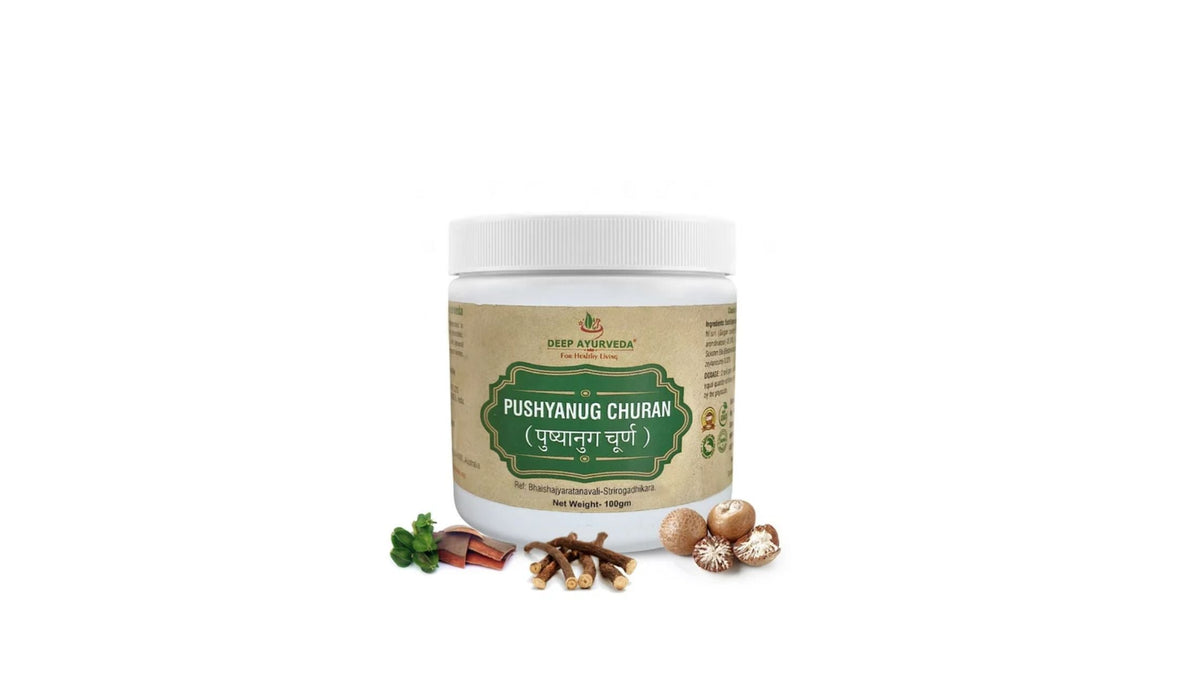
Pushyanug Churna is a classical Ayurvedic polyherbal formulation traditionally used in conditions associated with Pradara, Asrigdara, Shvetapradara, Rajodosha and Yonidosha. The classical formulation, known as Pusyanuga Curna, contains multiple herbs and a mineral ingredient, with the combination traditionally selected for properties such as Kashaya (astringent), Grahi (absorbent), Stambhana and Pitta-supportive action.
In practical terms, Pushyanug Churna is most commonly discussed in Ayurveda in relation to excessive vaginal discharge and certain menstrual bleeding disorders. However, vaginal discharge and abnormal bleeding can have many different causes, so the formulation should not be treated as a universal remedy or used for self-diagnosis.
Recent CCRAS research has also evaluated Pushyanug Churna in women diagnosed with bacterial vaginosis presenting as Swetapradara, adding newer clinical information to the traditional Ayurvedic understanding.
This guide explains its classical ingredients, Ayurvedic uses, potential benefits, dosage, Anupana, modern research, safety precautions and the situations in which medical evaluation is more important than self-treatment.
What Is Pushyanug Churna?
Pushyanug Churna, also written as Pushyanuga Churna or Pusyanuga Curna, is a powdered Ayurvedic formulation made from a combination of herbs and purified Gairika (red ochre).
The formulation is traditionally associated with disorders involving excessive discharge or bleeding. The classical formulation database records its combined indications as Asrgdhara, Shvetapradara, Rajodosha, Arsa and Yonidosha.
Rather than considering Pushyanug Churna simply a women's health powder, it is more useful to understand the formulation through its Ayurvedic actions. A number of its ingredients are traditionally described as astringent, absorbent, cooling or supportive of digestive balance.
Pushyanug Churna Ingredients: What Is in the Classical Formulation?
One of the most important things to understand is that not every product sold under the name Pushyanug Churna necessarily has an identical ingredient list. Commercial products can vary in composition, form and dosage instructions.
The classical Pusyanuga Curna reference lists 26 ingredients, with each ingredient used in a specified proportion. The formulation is prepared by separately processing and powdering the ingredients before blending them into a homogeneous Churna.
Classical ingredients of Pushyanug Churna
The classical formulation includes ingredients such as:
- Patha
- Jambu
- Amra
- Pashanabheda
- Rasanjana
- Ambastha
- Mocharasa
- Samanga
- Padmakesara
- Ativisha
- Musta
- Bilva
- Lodhra
- Gairika
- Katphala
- Maricha
- Shunthi
- Draksha
- Rakta Chandana
- Aralu
- Kutaja
- Ananta
- Dhataki
- Yashtimadhu
- Arjuna
- and other classical components recorded in the formulation reference.
Because botanical identification can vary between Ayurvedic references and commercial labels, readers should check the specific manufacturer's label before assuming that every Pushyanug Churna contains exactly the same ingredients.
Why Does Pushyanug Churna Contain So Many Ingredients?
This is where the formulation becomes more interesting than a simple list of herbs.
Ayurvedic formulations are often designed around a combination of actions rather than one main herb.
Pushyanug Churna brings together herbs traditionally associated with:
- Kashaya (astringent) action
- Grahi (absorbent) action
- Stambhana-supportive action
- Pitta-oriented management
- Digestive support
- Local tissue-supportive properties
- Balancing of excessive discharge or bleeding patterns
This combination helps explain why the formulation appears in classical Ayurvedic discussions of both Pradara and Asrigdara, rather than being limited to one symptom.
Key Ingredient Groups in Pushyanug Churna
Astringent and Stambhana-oriented ingredients
Ingredients such as Lodhra, Jambu, Amra, Kutaja, Arjuna and Gairika are traditionally associated with astringent or consolidating actions.
In Ayurveda, Kashaya Rasa is commonly discussed in relation to qualities such as absorption and contraction. Stambhana is a broader therapeutic concept used when excessive flow needs to be controlled.
This should not be interpreted as meaning that every type of bleeding should automatically be suppressed. The underlying cause of bleeding must first be understood.
Digestive-supporting ingredients
Ingredients including Shunthi, Maricha and Musta are traditionally valued for their relationship with digestion and Agni.
This is significant because Ayurveda does not always view reproductive health in isolation. Digestive function, Dosha balance and tissue metabolism are considered interconnected.
Cooling and Pitta-oriented ingredients
Ingredients such as Rakta Chandana, Ananta and Gairika are traditionally used in formulations where heat, irritation or Pitta-related features are considered relevant.
This helps explain the broader Ayurvedic logic of Pushyanug Churna rather than reducing it to a single action.
Tissue-supportive ingredients
Ingredients such as Yashtimadhu, Draksha and Arjuna contribute additional properties to the overall formulation.
The important point is that Pushyanug Churna is a multi-drug formulation, and its traditional rationale comes from the combined properties of its ingredients rather than from one herb alone.
How Does Pushyanug Churna Work According to Ayurveda?
Ayurveda does not describe herbal formulations only in terms of modern pharmacological mechanisms. Instead, formulations are understood through concepts such as Rasa, Guna, Virya, Vipaka, Dosha and therapeutic action.
Pushyanug Churna is traditionally associated with a predominantly Kashaya-oriented approach, along with Grahi and Stambhana-related actions.
Kashaya Rasa
Kashaya, or astringent taste, is traditionally associated with properties that can support absorption and reduction of excessive secretions.
Grahi action
Grahi is an Ayurvedic therapeutic concept associated with helping retain or consolidate excessive fluid and supporting appropriate stool consistency.
Stambhana action
Stambhana refers broadly to checking excessive flow. In the context of classical indications, this helps explain why Pushyanug Churna is associated with certain bleeding and discharge disorders.
Pitta-oriented approach
Some of the ingredients are traditionally selected for their cooling or Pitta-supportive characteristics.
However, Ayurvedic treatment is individualized. A formulation that is appropriate in one presentation may not be appropriate in another simply because the symptom appears similar.
Traditional Ayurvedic Uses of Pushyanug Churna
The classical formulation reference associates Pusyanuga Curna with Asrgdhara, Shvetapradara, Rajodosha, Arsa and Yonidosha.
Let's understand these traditional indications more carefully.
Pushyanug Churna for Pradara
Pradara is an Ayurvedic term associated with excessive vaginal discharge or flow depending on the context.
Pushyanug Churna is traditionally discussed in Pradara because of its Kashaya, Grahi and Stambhana-oriented properties.
The important point is that the Ayurvedic diagnosis matters. White discharge is a symptom, not necessarily one disease.
Pushyanug Churna for Shvetapradara
Shvetapradara literally refers to a condition involving whitish vaginal discharge in Ayurvedic terminology.
Ayurvedic management depends on the nature of the discharge and associated features.
Modern medicine also recognizes that vaginal discharge can be:
- Normal physiological discharge
- Infection-related
- Hormonal
- Associated with irritation
- Related to other gynaecological conditions
Therefore, Pushyanug Churna should not be automatically used for every case of white discharge.
Pushyanug Churna for Asrigdara
Asrigdara is a classical Ayurvedic term associated with excessive or abnormal uterine bleeding.
This is one of the traditional contexts in which Pushyanug Churna is discussed.
From a modern medical perspective, however, heavy or abnormal menstrual bleeding can have several causes, including hormonal disorders, fibroids, adenomyosis, bleeding disorders and other gynaecological conditions.
For this reason, persistent or unusually heavy bleeding should be evaluated rather than simply suppressed with an herbal formulation.
Pushyanug Churna for Rajodosha
Rajodosha broadly relates to disturbances of menstruation in Ayurvedic terminology.
The formulation's traditional properties may make it relevant in selected presentations, but Ayurvedic treatment should be based on the complete clinical picture rather than the presence of irregular menstruation alone.
Other Classical Indications
The classical reference also records Arsa and Yonidosha among the combined disease indications.
Some modern product pages additionally discuss applications involving piles and loose stools because of the formulation's traditional Kashaya and Grahi properties.
These uses should be understood within the appropriate Ayurvedic context rather than treated as universal indications.
Pushyanug Churna Benefits: What Does Ayurveda Traditionally Suggest?
Instead of viewing Pushyanug Churna as a medicine with a long list of guaranteed benefits, it is better to understand the benefits in terms of traditional Ayurvedic indications and properties.
1. Traditionally used for excessive vaginal discharge
Its Kashaya and Grahi-oriented properties are one reason it is traditionally used in selected Pradara and Shvetapradara presentations.
2. Traditionally used in certain excessive menstrual bleeding patterns
Its classical association with Asrigdara explains its traditional use in selected bleeding disorders.
3. Supports an Ayurvedic astringent approach
Several ingredients contribute Kashaya-oriented properties to the formulation.
4. Traditionally used for selected Yonidosha
The classical formulation is associated with Yonidosha, a broad Ayurvedic category involving vaginal or female reproductive disorders.
5. Provides digestive-supportive herbs
Ingredients such as Shunthi, Maricha and Musta contribute traditionally recognized Deepana-Pachana-oriented properties.
6. Supports a broader Dosha-based approach
The formulation combines ingredients with different properties rather than relying on one herb alone.
Important: These are traditional Ayurvedic uses and properties. They should not be interpreted as proof that Pushyanug Churna can cure every modern condition associated with vaginal discharge or abnormal bleeding.
What Does Modern Research Say About Pushyanug Churna?
This is an important area where newer information adds value beyond older online articles.
The Central Council for Research in Ayurvedic Sciences (CCRAS) lists a completed clinical evaluation of Pushyanug Churna for Sweta Pradara with reference to bacterial vaginosis (leucorrhoea). The study was published in the Journal of Research in Ayurvedic Sciences in 2025.
CCRAS clinical evaluation in Swetapradara
The CCRAS bulletin describes a clinical investigation involving 80 women aged 18–40 years who had been clinically diagnosed with bacterial vaginosis and presented with abnormal white vaginal discharge.
The intervention used:
- Pushyanug Churna: 3 g twice daily
- Anupana: Tandulodaka
- Timing: after meals
- Treatment duration: 60 days
- Assessments: every 15 days
- Follow-up: 90 days after treatment
The bulletin reports symptom improvements among participants who completed the study, including reductions in fishy odour, burning, dysuria and itching.
What does this research actually tell us?
It provides useful clinical evidence that the formulation deserves further study.
But it does not mean:
Pushyanug Churna cures bacterial vaginosis in everyone.
A single clinical investigation cannot establish universal effectiveness for every patient or every cause of vaginal discharge.
It is better to interpret the evidence as promising but still requiring broader and stronger clinical research.
Pushyanug Churna Dosage
Dosage is one area where readers should be particularly careful because different products and clinical situations can have different instructions.
The classical formulation reference records a dosage of 6 g daily in divided doses, with milk or Tandulodaka described as Anupana.
The recent CCRAS clinical investigation described above used 3 g twice daily with Tandulodaka after meals for 60 days.
At the same time, current commercial products may provide different serving sizes. For example, some products available in India list 2–3 g doses, while others specify different quantities.
Therefore, there is no single internet dosage that is appropriate for everyone.
A qualified Ayurvedic practitioner should consider:
- The actual diagnosis
- Age
- Prakriti
- Dosha involvement
- Severity and duration of symptoms
- Other medicines
- Pregnancy or lactation status
- The exact product and formulation
before deciding the appropriate dose and duration.
How to Take Pushyanug Churna?
Traditionally, Pushyanug Churna may be administered with an Anupana, which is the substance taken along with an Ayurvedic medicine to support its administration and therapeutic context.
Classical references mention Tandulodaka or milk as Anupana.
Some current product instructions also recommend rice-washed water, honey or water depending on the specific formulation.
General practical guidance
- Use the measuring spoon or quantity recommended by your practitioner.
- Follow the manufacturer's label when using a specific commercial product.
- Do not increase the dose because symptoms are severe.
- Do not continue treatment indefinitely without reassessment.
- If symptoms persist or worsen, investigate the underlying cause.
What Is Tandulodaka?
Tandulodaka is traditionally prepared using rice and water and is commonly translated as rice-washed water or rice water in Ayurvedic contexts.
It is mentioned as an Anupana for Pushyanuga Curna in classical formulation information, and it was also used in the recent CCRAS clinical investigation.
This is an important detail because many articles mention take with rice water without explaining what the term actually means.
Pushyanug Churna for White Discharge: What Should Women Know?
White vaginal discharge is not automatically a disease.
A healthy vagina normally produces discharge, and its amount and consistency can change with:
- Menstrual cycle
- Ovulation
- Hormonal changes
- Pregnancy
- Sexual activity
Concern increases when discharge is accompanied by symptoms such as:
- Strong or foul odour
- Significant itching
- Burning
- Pain
- Green or yellow discharge
- Pain while urinating
- Pelvic pain
- Bleeding outside the expected menstrual period
These symptoms may indicate an infection or another medical condition requiring proper evaluation.
Therefore, the Ayurvedic concept of Shvetapradara should not simply be equated with every instance of modern vaginal discharge.
Pushyanug Churna for Heavy Menstrual Bleeding
Pushyanug Churna is traditionally associated with Asrigdara, an Ayurvedic condition involving excessive menstrual or uterine bleeding.
But heavy menstrual bleeding can have multiple modern medical causes.
Seek medical evaluation if:
- Bleeding is unusually heavy
- You are soaking pads or tampons much more frequently than normal
- Bleeding continues for an unusually long period
- Large clots occur repeatedly
- You experience weakness, dizziness or breathlessness
- Bleeding occurs during pregnancy
- Bleeding occurs after menopause
- There is severe pelvic pain
Heavy bleeding can also contribute to iron deficiency and anaemia.
The priority should therefore be to identify the reason for abnormal bleeding rather than relying only on a symptom-suppressing approach.
Pushyanug Churna Side Effects and Safety
There is limited high-quality evidence establishing a complete safety profile for Pushyanug Churna across all populations and long-term use.
Therefore, natural should not be interpreted as automatically safe for everyone.
Some people may experience digestive or individual intolerance to herbal formulations, while the suitability of particular ingredients can depend on the person's health status and concurrent medicines.
Who should seek professional advice before using it?
Extra caution is appropriate for:
- Pregnant women
- Breastfeeding women
- Children
- Older adults with multiple medicines
- People with significant chronic diseases
- People taking prescription medicines
- People with unexplained vaginal bleeding
- People with recurrent or unexplained vaginal discharge
Current product guidance also commonly recommends professional consultation for pregnancy, lactation, children and people with serious health conditions.
Can Pushyanug Churna Be Taken During Pregnancy?
Do not self-medicate with Pushyanug Churna during pregnancy.
There is not enough evidence to recommend routine unsupervised use during pregnancy. Any Ayurvedic formulation during pregnancy should be selected by a qualified practitioner who understands the pregnancy stage, clinical indication, formulation and complete ingredient profile.
Bleeding or abnormal vaginal discharge during pregnancy should receive appropriate medical assessment rather than being managed solely through self-treatment.
Can Pushyanug Churna Be Used Long Term?
There is no universal answer.
The classical formulation reference records a treatment duration of approximately 2–3 months, but treatment duration should not automatically be applied to every person or every commercial product.
Long-term use should depend on:
- Why the formulation was prescribed
- Whether symptoms are improving
- The individual's constitution and health status
- The exact formulation being used
- Other medicines
- Clinical reassessment
If the original problem persists after the expected treatment period, simply continuing the same formulation is not always the best approach.
Pushyanug Churna With Other Medicines
If you take prescription medicines, tell your doctor or Ayurvedic practitioner before starting Pushyanug Churna.
This is especially important when you are using medicines for:
- Hormonal or reproductive conditions
- Blood-related disorders
- Chronic diseases
- Blood pressure
- Diabetes
- Other Ayurvedic formulations
- Long-term medication
Do not assume that an herbal formulation cannot interact with other medicines.
Classical Pushyanuga Churna vs Commercial Pushyanug Churna
This is one of the most important points for consumers.
The term Pushyanug Churna can refer to products manufactured by different companies, and their labels may not be identical.
For example, current Indian listings show differences in ingredient descriptions, dosage instructions and product compositions among manufacturers.
Therefore:
Classical formulation does not always mean every commercial product is identical.
Before buying, check:
- Complete ingredient list
- Botanical names where provided
- Net quantity
- Batch number
- Manufacturing details
- Expiry date
- Recommended dosage
- Manufacturer information
- Appropriate quality and regulatory information
This simple check can prevent confusion when comparing two products carrying similar names.
How to Choose a Good Pushyanug Churna
When purchasing an Ayurvedic Churna, don't choose solely on the basis of claims such as 100% natural or fast results.
Instead, look for:
1. Transparent ingredients
The label should clearly identify the ingredients.
2. Reliable manufacturer
Choose a manufacturer that provides appropriate manufacturing and product information.
3. Clear dosage instructions
The product should specify how it is intended to be used.
4. Batch and expiry information
Always check these before consumption.
5. Avoid exaggerated medical claims
Be cautious of products claiming to permanently cure complex gynaecological disorders.
6. Match the formulation to the actual condition
A product should not be selected simply because its name appears in a Google search for a symptom.
When Should You NOT Self-Treat With Pushyanug Churna?
Pushyanug Churna should not be used as a substitute for medical evaluation when symptoms could indicate a serious underlying condition.
Seek appropriate medical attention for:
- Very heavy menstrual bleeding
- Bleeding during pregnancy
- Bleeding after menopause
- Severe abdominal or pelvic pain
- Fever with vaginal symptoms
- Foul-smelling discharge
- Green or yellow discharge
- Recurrent unexplained discharge
- Severe weakness, dizziness or fainting
- Persistent symptoms despite treatment
The purpose of Ayurvedic treatment is not simply to suppress a symptom. The underlying cause and the individual's overall health need to be considered.
Final Ayurvedic Perspective
Pushyanug Churna is a classical Ayurvedic multi-ingredient formulation traditionally associated with Pradara, Shvetapradara, Asrigdara, Rajodosha and Yonidosha. Its formulation combines ingredients with Kashaya, Grahi, Stambhana and other traditionally valued properties.
Recent CCRAS research provides encouraging clinical information in selected women with Swetapradara associated with bacterial vaginosis, but the available evidence should still be interpreted carefully and not converted into blanket treatment claims.
Frequently Asked Questions About Pushyanug Churna
What is Pushyanug Churna used for?
Pushyanug Churna is traditionally used in Ayurveda for selected conditions associated with Pradara, Shvetapradara, Asrigdara, Rajodosha and Yonidosha.
What are the main ingredients of Pushyanug Churna?
The classical Pusyanuga Curna is a multi-ingredient formulation containing herbs such as Patha, Jambu, Amra, Lodhra, Kutaja, Musta, Bilva, Dhataki, Yashtimadhu and Arjuna, along with other ingredients and purified Gairika.
Is Pushyanug Churna useful for white discharge?
It is traditionally used in selected Ayurvedic presentations of Shvetapradara. However, not every case of vaginal discharge is a disease, and abnormal discharge with odour, itching, burning or pain should be medically evaluated.
Can Pushyanug Churna help with heavy periods?
Pushyanug Churna is traditionally associated with Asrigdara, an Ayurvedic description involving excessive bleeding. Persistent or very heavy menstrual bleeding should be evaluated to identify the underlying cause.
What is the dosage of Pushyanug Churna?
Dosage varies according to the formulation and clinical context. Classical references record 6 g daily in divided doses, while a recent CCRAS clinical investigation used 3 g twice daily with Tandulodaka. Follow the dosage prescribed by a qualified practitioner or stated for the specific product.
What is the best Anupana for Pushyanug Churna?
Classical formulation information mentions Tandulodaka or milk as Anupana. The appropriate Anupana can depend on the formulation and individual clinical context.
What is Tandulodaka?
Tandulodaka is traditionally prepared from rice and water and is commonly described as rice-washed water or rice water. It is mentioned as an Anupana for Pusyanuga Curna and was used in a recent CCRAS clinical study.
Can Pushyanug Churna be taken during pregnancy?
Self-use during pregnancy is not recommended. Consult a qualified healthcare professional before taking any Ayurvedic formulation during pregnancy.
Can Pushyanug Churna be taken for a long time?
Treatment duration should be individualized. The classical formulation reference lists a duration of 2–3 months, but this should not be treated as a universal instruction for every person or product.
Are all Pushyanug Churna products the same?
No. Commercial products can differ in ingredient descriptions, formulation details and dosage instructions. Always check the specific product label.
Is there scientific research on Pushyanug Churna?
Yes. CCRAS lists a completed clinical evaluation of Pushyanug Churna for Swetapradara with reference to bacterial vaginosis, published in the Journal of Research in Ayurvedic Sciences in 2025.
Can Pushyanug Churna replace treatment for a vaginal infection?
It should not automatically be considered a replacement for diagnosis or appropriate treatment of a vaginal infection. Symptoms such as foul-smelling discharge, pain, itching, burning or fever warrant proper clinical assessment.