
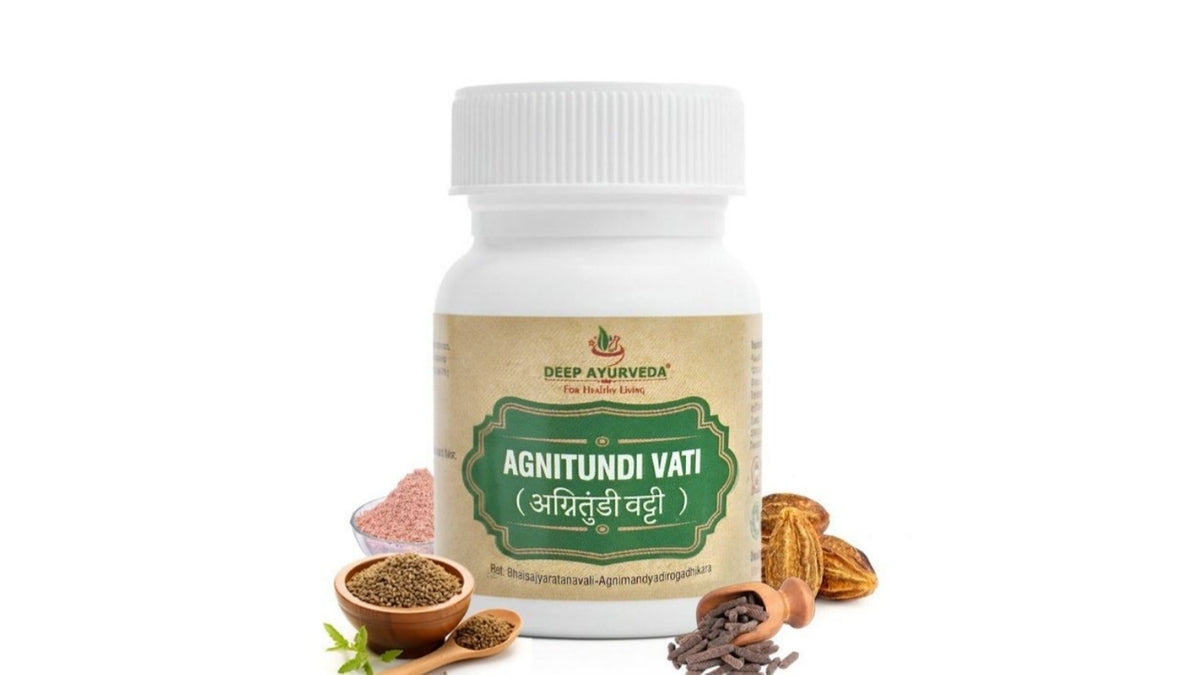
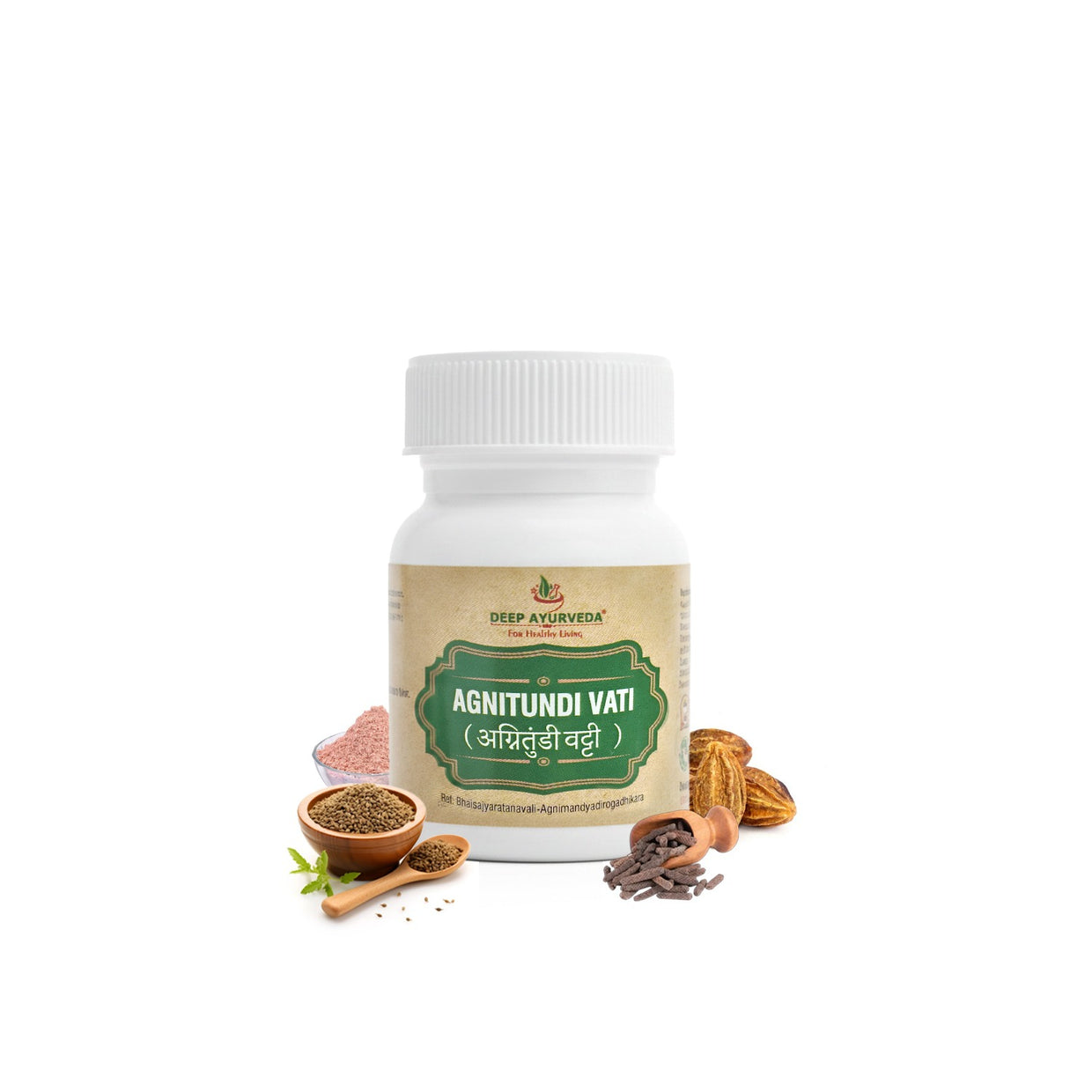
Deep Ayurveda Agnitundi Vati
✅ Supports Healthy Digestion ✅Helps Improve Appetite ✅ Reduces Gas and Bloating✅ Supports Relief from Indigestion ✅Supports Metabolic Function
Agnitundi Vati is a classical Ayurvedic formulation traditionally used to support digestive fire (Agni), stimulate appetite, reduce bloating, and help manage symptoms associated with weak digestion (Agnimandya). The formulation combines digestive herbs, salts, alkalis, and purified Ayurvedic ingredients that work together to promote digestive efficiency when used appropriately under professional guidance. Unlike many modern digestive supplements that focus on temporary symptom relief, Agnitundi Vati is designed according to Ayurvedic principles to address the underlying imbalance in digestion. Ayurveda considers healthy digestion to be the foundation of overall health, and Agnitundi Vati has been traditionally used to strengthen this foundation.
Table of Contents
- What Is Agnitundi Vati?
- Classical Ayurvedic Background
- Understanding Agnimandya and Digestive Fire
- Signs That Your Digestive Fire May Be Weak
- Ingredients in Agnitundi Vati
- How Agnitundi Vati Works in Ayurveda
- Traditional Uses of Agnitundi Vati
- Potential Benefits
- Dosha-Based Perspective
- Dosage and Administration
- Side Effects and Safety
- Who Should Avoid Agnitundi Vati?
- Comparison With Other Ayurvedic Digestive Formulations
- Conclusion
What Is Agnitundi Vati?
In Ayurveda, digestion is not viewed merely as the breakdown of food. It is considered a vital process that influences energy production, tissue nourishment, immunity, mental clarity, and overall well-being.
The name Agnitundi itself reflects its traditional purpose:
- Agni = Digestive fire
- Tundi = Stimulating, awakening, or activating
Together, the name suggests a formulation intended to kindle weakened digestive fire.
Traditionally, Ayurvedic practitioners have used Agnitundi Vati when signs of impaired digestion, poor appetite, heaviness after meals, bloating, or accumulation of Ama (metabolic toxins) are present.
It is important to understand that Agnitundi Vati is not considered a universal digestive remedy. In Ayurveda, the selection of any formulation depends on an individual's constitution (Prakriti), digestive strength, symptoms, age, and overall health status.
Classical Ayurvedic Background
Agnitundi Vati is described in classical Ayurvedic literature and is traditionally associated with the management of Agnimandya (weak digestive fire).
Ayurveda places extraordinary importance on digestion because all nourishment depends on proper digestive function. According to classical Ayurvedic principles:
- Strong Agni supports health.
- Weak Agni contributes to disease.
- Irregular Agni creates digestive instability.
- Excessively sharp Agni may also create imbalance.
Because digestive disturbances are often viewed as the starting point for many health concerns, Ayurvedic physicians historically developed specialized formulations such as Agnitundi Vati to support digestive function.
The formulation combines herbs known for Deepana (kindling digestive fire), Pachana (supporting the processing of Ama), and Vata-Kapha balancing properties.
Understanding Agnimandya: The Root Cause of Many Digestive Complaints
Agnimandya refers to reduced digestive capacity according to Ayurveda. It is commonly associated with poor appetite, bloating, heaviness after meals, gas formation, sluggish digestion, and the accumulation of Ama.
Modern lifestyles often create conditions that Ayurveda associates with weakened digestion.
Common contributing factors include:
- Overeating
- Irregular meal timing
- Excessive processed food consumption
- Sedentary lifestyle
- Chronic stress
- Late-night eating
- Frequent snacking
- Poor sleep habits
When digestive fire weakens, food may not be processed efficiently. Ayurveda suggests that this can contribute to the formation of Ama, a concept describing incompletely processed metabolic by-products.
Signs That Your Digestive Fire May Be Weak
Self-Assessment Checklist
According to Ayurveda, a weakened digestive fire (Agnimandya) often develops gradually rather than appearing overnight. Many people experience subtle digestive changes for months before realizing that their digestion is not functioning optimally. If you frequently notice the following signs, it may indicate that your digestive strength needs attention.
Appetite-Related Signs
-
Reduced Hunger: You rarely feel naturally hungry at regular meal times and often eat only because it is time to eat rather than because your body is asking for food.
-
Feeling Full After Eating Small Amounts: Even a small meal may leave you feeling overly full or uncomfortable, making it difficult to complete a normal portion.
-
Lack of Interest in Meals: Food may seem less appealing than usual, and you may not look forward to meals despite long gaps between eating.
- Skipping Meals Without Noticing Hunger: You may go several hours without eating and still not experience a strong desire for food, which Ayurveda considers a possible sign of weak Agni.
Digestive Signs
-
Bloating After Meals: Your abdomen may feel swollen, tight, or uncomfortable shortly after eating, especially after heavier meals.
-
Excessive Gas Formation: Frequent gas production throughout the day may indicate that food is not being digested and processed efficiently.
-
Frequent Burping: Repeated belching after meals can sometimes be associated with sluggish digestion and the accumulation of undigested food.
-
Heaviness in the Stomach: Instead of feeling energized after eating, you may experience a lingering sensation of heaviness or sluggishness for several hours.
- Slow or Sluggish Digestion: Meals may seem to remain in the stomach for an extended period, often accompanied by discomfort or a lack of appetite for the next meal.
Energy-Related Signs
-
Fatigue After Eating: Rather than providing energy, meals may leave you feeling sleepy, tired, or less productive shortly afterward.
-
Midday Energy Crashes: You may notice a significant drop in energy levels during the day, particularly after lunch or larger meals.
- Mental Dullness After Meals: Difficulty concentrating, reduced mental clarity, or a feeling of brain fog after eating can sometimes be linked to impaired digestion.
Bowel-Related Signs
-
Irregular Bowel Movements: Digestive imbalance may contribute to inconsistent bowel habits, including variations in timing, frequency, or stool consistency.
-
Incomplete Evacuation: Even after a bowel movement, you may feel that the bowels have not emptied completely.
- Digestive Discomfort After Eating: Recurring abdominal discomfort, mild cramping, or digestive uneasiness following meals may indicate that digestion is not functioning efficiently.
Important Note
Experiencing one or two of these symptoms occasionally is common and does not necessarily indicate a digestive disorder. However, if multiple symptoms occur regularly or persist for an extended period, it is advisable to consult a qualified healthcare professional or Ayurvedic practitioner for a proper evaluation. Understanding the underlying cause of digestive discomfort is essential before starting any herbal or Ayurvedic formulation, including Agnitundi Vati.
Ingredients in Agnitundi Vati
Agnitundi Vati contains a combination of herbs, salts, alkalis, and purified Ayurvedic ingredients that traditionally support digestion, stimulate appetite, and assist in balancing digestive function.
While formulations may vary slightly between manufacturers, common ingredients often include:
| Ingredient | Traditional Ayurvedic Action | Digestive Support Role |
|---|
| Ajamoda | Deepana-Pachana | Supports digestion |
| Chitraka | Digestive stimulant | Traditionally used to kindle Agni |
| Jeeraka | Carminative | Helps digestive comfort |
| Vidanga | Digestive support | Traditionally used in Ama management |
| Triphala | Balanced digestive support | Supports digestive regularity |
| Saindhava Lavana | Gentle digestive salt | Supports digestive processes |
| Yava Kshara | Alkaline preparation | Traditionally used in digestive formulations |
| Sarjikakshara | Alkaline preparation | Supports digestive balance |
| Purified Vatsanabha | Classical Ayurvedic ingredient | Included only after purification |
| Purified Vishamushti | Classical Ayurvedic ingredient | Used under traditional Ayurvedic processing methods |
Chitraka
Among the many herbs used in Ayurvedic digestive formulations, Chitraka (Plumbago zeylanica) holds a special place because of its strong Deepana (digestive fire-kindling) properties. Classical Ayurvedic texts frequently mention Chitraka in formulations designed for individuals experiencing weak digestion, poor appetite, and digestive sluggishness.
Traditionally, Ayurvedic practitioners value Chitraka for the following reasons:
-
Supporting digestive fire (Agni): Chitraka is traditionally used to stimulate weakened digestive activity and help the body process food more efficiently, particularly when digestion feels slow or incomplete.
-
Enhancing appetite: Individuals experiencing reduced hunger or a lack of interest in meals may benefit from formulations containing Chitraka, as it has traditionally been used to encourage healthy appetite and digestive readiness.
-
Assisting in sluggish digestion: Ayurveda associates sluggish digestion with the accumulation of Ama. Chitraka is traditionally included in formulations that aim to improve digestive efficiency and reduce digestive stagnation.
- Helping reduce Kapha-related digestive heaviness: When digestive discomfort is accompanied by feelings of heaviness, lethargy, or post-meal fullness, Chitraka is often valued for its warming and stimulating qualities.
Because Chitraka is considered a potent and heating herb, Ayurvedic practitioners typically evaluate an individual's constitution (Prakriti), digestive strength, and symptom pattern before recommending formulations that contain it.
Ajamoda
Ajamoda (Trachyspermum roxburghianum) has been used for generations in traditional Ayurvedic digestive formulations. It is particularly valued for its ability to support digestive comfort while helping maintain healthy digestive function.
Traditional Ayurvedic uses of Ajamoda include:
-
Supporting digestion: Ajamoda is commonly included in digestive formulations because it is traditionally believed to encourage proper digestion and support the body's natural digestive processes.
-
Promoting digestive comfort: It has long been used in Ayurveda to help maintain abdominal comfort, especially after heavy meals or during periods of digestive sluggishness.
-
Assisting with occasional bloating: Ajamoda is traditionally valued for helping manage occasional gas formation and abdominal fullness that may occur due to impaired digestion.
- Helping maintain digestive balance: By supporting digestive function and reducing digestive stagnation, Ajamoda plays an important role in many classical digestive formulations.
Its naturally warming qualities make Ajamoda particularly useful in digestive conditions associated with Vata and Kapha imbalances, where coldness, heaviness, and sluggishness are commonly observed.
Triphala
Triphala is one of Ayurveda's most respected and widely used formulations. Rather than being a single herb, it is a combination of three fruits that work together to support digestive and overall wellness.
Triphala consists of:
-
Haritaki (Terminalia chebula): Traditionally valued for supporting healthy digestion, elimination, and overall gastrointestinal balance.
-
Bibhitaki (Terminalia bellirica): Commonly used in Ayurveda to support digestive function and help maintain internal balance.
- Amalaki (Emblica officinalis): Revered for its nourishing properties and traditionally used to support digestive as well as overall wellness.
Together, these three fruits are traditionally valued for:
-
Supporting digestive regularity: Triphala is widely recognized for helping maintain healthy bowel function and digestive rhythm.
-
Promoting gut health: Its balanced nature makes it a common ingredient in Ayurvedic wellness routines aimed at supporting long-term digestive health.
-
Encouraging balanced elimination: Ayurveda traditionally uses Triphala to support the body's natural elimination processes without creating excessive dependency.
- Supporting overall digestive wellness: Rather than targeting a single digestive concern, Triphala is valued for its broad-spectrum role in maintaining digestive balance.
Its inclusion in Agnitundi Vati helps create a more balanced digestive formulation, complementing stronger digestive stimulants while contributing to overall digestive harmony.
Why Agnitundi Vati Is Considered a Potent Formulation
One of the reasons Agnitundi Vati continues to be widely discussed in Ayurvedic digestive care is its comprehensive formulation strategy. Unlike products that focus on only one aspect of digestion, Agnitundi Vati combines multiple ingredients traditionally selected to address different dimensions of digestive health.
The formulation is traditionally designed to:
-
Kindle digestive fire (Agni): Several ingredients work together to support weakened digestion and encourage more efficient processing of food.
-
Improve appetite: The formulation has traditionally been used when reduced hunger or poor appetite is associated with weak digestive fire.
-
Support healthy digestion: By combining Deepana and Pachana herbs, Agnitundi Vati aims to support multiple stages of the digestive process.
-
Reduce digestive stagnation: Ayurveda associates sluggish digestion with heaviness and discomfort; the formulation is traditionally used to help address these concerns.
-
Balance Vata and Kapha influences: Many ingredients possess warming and stimulating properties that are traditionally considered beneficial in Vata-Kapha dominant digestive imbalances.
- Address Ama accumulation: Ayurvedic practitioners often use formulations like Agnitundi Vati when signs of incomplete digestion and Ama accumulation are present.
This multi-dimensional approach reflects a fundamental Ayurvedic principle: digestive health is rarely influenced by a single factor. By addressing appetite, digestive fire, Ama, and doshic balance simultaneously, Agnitundi Vati is traditionally viewed as a comprehensive digestive support formulation rather than a symptom-specific remedy.
How Agnitundi Vati Works in Ayurveda
One of the biggest gaps in modern digestive discussions is that they often focus only on symptoms. Ayurveda focuses on digestive function itself.
Agnitundi Vati works through four important Ayurvedic principles.
1. Deepana (Kindling Digestive Fire)
The formulation contains ingredients traditionally known for stimulating digestive capacity and improving appetite.
This is particularly useful when digestive strength becomes sluggish due to dietary indiscretions, sedentary habits, or seasonal influences.
2. Pachana (Digesting Ama)
Ayurveda suggests that weak digestion may result in the formation of Ama.
Agnitundi Vati is traditionally used to support the body's ability to process and clear this accumulated metabolic burden.
3. Vata-Kapha Balancing
Many digestive symptoms such as bloating, gas, heaviness, and sluggishness are associated with aggravated Vata and Kapha.
Several ingredients in the formulation are traditionally used to support balance in these doshas.
4. Supporting Digestive Efficiency
When Agni functions properly, food is transformed efficiently into nutrients and energy.
The ultimate goal of Agnitundi Vati is not simply symptom management but restoration of healthy digestive function.
Uses of Agnitundi Vati
Agnitundi Vati is a classical Ayurvedic formulation traditionally used to support digestive fire (Agni), improve appetite, reduce bloating, assist in managing gas formation, and address symptoms associated with Agnimandya or weak digestion. In Ayurveda, it is often considered when digestive discomfort stems from sluggish digestive function rather than a single isolated symptom.
One of the reasons Agnitundi Vati has remained relevant in Ayurvedic practice for centuries is its broad application in digestive wellness. Rather than focusing on just one complaint, Ayurvedic practitioners traditionally evaluate the overall state of digestion, appetite, bowel habits, and signs of Ama before recommending this formulation.
Let's explore its traditional uses in greater detail.
1. Traditionally Used for Poor Appetite
Loss of appetite is often considered one of the earliest signs that digestive fire is becoming weak. When the digestive system is not functioning efficiently, the body naturally loses interest in food and hunger signals may become less noticeable.
Many individuals experiencing weak digestion may notice:
-
Reduced hunger throughout the day, even after long gaps between meals, making it difficult to maintain a regular eating schedule.
-
Skipping meals unintentionally because there is little or no desire to eat despite the body's nutritional needs.
-
Feeling full after eating small portions, which may indicate that digestion is not processing food efficiently.
- Lack of interest in food and meals, even when favorite foods are available or meal times arrive.
According to Ayurveda, when Agni becomes weak, the body's natural demand for nourishment decreases. Agnitundi Vati is traditionally used to kindle digestive fire and support the return of a healthy appetite.
In Ayurvedic clinical practice, appetite is often viewed as a direct reflection of digestive strength. Restoring appetite is not simply about encouraging a person to eat more—it is about improving the body's ability to digest and utilize food effectively.
2. Traditionally Used for Bloating
Bloating is one of the most common digestive concerns reported by individuals with weak digestive fire. It may occur when food remains incompletely processed within the digestive tract, leading to discomfort and a sensation of fullness.
Common symptoms may include:
-
Abdominal fullness after meals, even when a moderate amount of food has been consumed.
-
A feeling of tightness or pressure in the stomach region, which may become more noticeable as the day progresses.
-
Visible abdominal distension, especially after eating foods that are difficult to digest.
- Persistent discomfort despite eating light meals, suggesting that digestion may not be functioning optimally.
From an Ayurvedic perspective, bloating is frequently associated with aggravated Vata and impaired digestive activity. Agnitundi Vati is traditionally used to support digestion and help address factors that contribute to bloating.
3. Traditionally Used for Gas Formation
Gas formation is another digestive concern commonly associated with Agnimandya. While occasional gas is normal, excessive gas formation may indicate that food is not being digested efficiently.
Individuals may experience:
-
Frequent flatulence throughout the day, especially after meals that are heavy or difficult to digest.
-
Repeated belching after eating, which may be accompanied by a feeling of digestive discomfort.
-
Abdominal uneasiness or cramping, often linked to trapped gas within the digestive tract.
- Rumbling or gurgling sounds in the abdomen, which can occur when digestion becomes irregular.
Ayurvedic practitioners often assess whether gas formation is linked to poor food combinations, irregular eating habits, weak digestive fire, or Ama accumulation. By supporting digestion at its root, Agnitundi Vati is traditionally used to help manage these concerns.
4. Traditionally Used for Post-Meal Heaviness
Do you often feel tired, sleepy, or unusually heavy after eating? In Ayurveda, this symptom is considered an important indicator of digestive weakness.
Common signs may include:
-
Drowsiness after meals, making it difficult to remain active or productive during the day.
-
A noticeable lack of energy following food consumption, even when meals are balanced and moderate in size.
-
A sensation that food remains in the stomach for a long time, creating discomfort and sluggishness.
- Slow digestion and delayed hunger, where the next meal is skipped because the previous meal still feels undigested.
These symptoms may suggest that digestive activity is not functioning efficiently. Agnitundi Vati is traditionally used to stimulate digestive processes and support the proper breakdown of food.
5. Traditionally Used in Agnimandya
Agnimandya, or diminished digestive fire, is one of the primary Ayurvedic conditions for which Agnitundi Vati is traditionally described.
Signs commonly associated with Agnimandya may include:
-
Poor appetite that persists for weeks or months, reducing overall food intake and nutritional balance.
-
Frequent bloating and abdominal discomfort, particularly after meals.
-
Recurring indigestion, where food feels difficult to digest despite dietary modifications.
-
Excessive gas formation and belching, often occurring alongside heaviness.
-
A constant feeling of heaviness in the body, particularly after eating.
-
Irregular bowel habits, including occasional constipation or incomplete evacuation.
- Accumulation of Ama, which Ayurveda considers a consequence of inefficient digestion.
Rather than treating these symptoms individually, Ayurveda focuses on strengthening Agni itself. This is one reason Agnitundi Vati is often regarded as a foundational digestive-support formulation.
6. Traditionally Used for Ama Accumulation
Ama is a unique Ayurvedic concept that refers to improperly processed metabolic waste believed to accumulate when digestion becomes weak. According to Ayurveda, the formation of Ama can interfere with normal physiological processes and contribute to digestive discomfort.
Traditional signs associated with Ama may include:
-
A thick coating on the tongue, especially noticeable in the morning before brushing.
-
Persistent digestive sluggishness, where meals feel difficult to process regardless of food choices.
-
Unexplained fatigue or low energy levels, even after adequate rest and sleep.
-
Bad breath or an unpleasant taste in the mouth, which may be associated with digestive imbalance.
- A general feeling of heaviness throughout the body, often accompanied by reduced enthusiasm and vitality.
Many ingredients in Agnitundi Vati are classified as Deepana and Pachana substances in Ayurveda. These categories are traditionally used to support digestive fire and assist in the processing of Ama.
Potential Benefits of Agnitundi Vati
The potential benefits of Agnitundi Vati are primarily related to digestive wellness. Traditionally, it is used to support appetite, improve digestive efficiency, reduce bloating, assist with gas management, and help maintain healthy digestive fire.
While individual experiences may vary, the following benefits are commonly associated with traditional Ayurvedic use.
Supports Healthy Digestive Function
Healthy digestion involves much more than simply avoiding stomach discomfort. Efficient digestion plays an important role in overall wellness by helping the body process food and derive nourishment from it.
Good digestive function may help support:
-
Nutrient absorption, allowing the body to effectively utilize vitamins, minerals, and other essential nutrients obtained through food.
-
Energy production, since properly digested food provides the fuel required for daily activities and bodily functions.
-
Tissue nourishment, which Ayurveda considers essential for maintaining long-term health and vitality.
- Overall well-being, as digestion is viewed as the foundation of physical and metabolic balance.
Agnitundi Vati is traditionally used to support these digestive processes by helping maintain healthy digestive fire.
Encourages Natural Appetite
Many digestive formulations focus primarily on relieving symptoms. Agnitundi Vati, however, is traditionally valued for its ability to support digestive strength itself.
As digestive function improves, individuals may notice:
-
A more natural feeling of hunger before meals, indicating improved digestive readiness.
-
Greater interest in food, particularly when appetite has been diminished for an extended period.
-
More consistent meal patterns, helping support balanced nutrition and healthy eating habits.
- Improved satisfaction after meals, without excessive heaviness or discomfort.
This benefit is particularly important for individuals who regularly skip meals due to a lack of appetite.
Helps Reduce Occasional Bloating and Gas
Digestive discomfort can significantly affect daily comfort and quality of life. By supporting digestive efficiency, Agnitundi Vati is traditionally used to help manage common digestive complaints.
It may help support comfort in situations involving:
-
Bloating after meals, especially when associated with weak digestive function.
-
Excess gas formation, which can lead to abdominal discomfort and social inconvenience.
-
Abdominal fullness and heaviness, even after consuming moderate portions of food.
- Frequent belching, which may indicate incomplete digestive processing.
Supports Better Food Assimilation
Ayurveda teaches that consuming healthy food is only one part of the equation. The body must also be capable of digesting, absorbing, and utilizing nutrients effectively.
Efficient food assimilation may help support:
- Better utilization of nutrients obtained from food.
- Improved digestive efficiency throughout the day.
- Enhanced metabolic function according to Ayurvedic principles.
- Greater overall nourishment and vitality.
Supports Metabolic Activity
In Ayurveda, Agni is closely linked to metabolism and transformation within the body.
When digestive fire functions efficiently:
-
Food is processed more effectively, reducing the likelihood of digestive stagnation.
-
Energy production is supported, helping maintain daily vitality and activity levels.
-
Ama formation may be minimized, according to Ayurvedic theory.
- Digestive comfort is more easily maintained, especially after meals.
Because of this connection, Ayurveda considers digestive health a central pillar of overall wellness.
May Support Gut Comfort During Seasonal Changes
Seasonal transitions can have a noticeable impact on digestion. Changes in weather, dietary habits, and daily routines often influence appetite and digestive efficiency.
Many individuals experience:
-
Reduced appetite during the monsoon season, when digestion is traditionally believed to become weaker.
-
Sluggish digestion during colder months, often accompanied by heaviness after meals.
- Temporary digestive irregularities during lifestyle changes, travel, or shifts in routine.
For this reason, Ayurvedic practitioners often pay special attention to digestive support during seasonal transitions and periods of adjustment.
How to Take It Safely
The dosage of Agnitundi Vati can vary depending on factors such as age, digestive strength, body constitution (Prakriti), health status, and the specific formulation being used. Because this classical Ayurvedic medicine contains potent ingredients, it should ideally be taken under the guidance of a qualified Ayurvedic practitioner.
One of the most common questions people ask is:
How much Agnitundi Vati should I take?
The answer is not always straightforward because Ayurveda emphasizes individualized treatment rather than a standard approach for everyone.
Why Dosage Matters
Many people assume that if a digestive remedy works, taking more of it will produce better results.
Ayurveda takes the opposite approach.
The goal is not to force digestion but to restore balance gradually.
Taking excessive amounts may not improve outcomes and could increase the risk of unwanted effects.
This is especially important with formulations that contain purified classical ingredients.
Best Time to Take Agnitundi Vati
Traditionally, Agnitundi Vati is often recommended around mealtimes because its primary Ayurvedic action is to support digestive fire (Agni). Since digestive capacity varies from person to person, the ideal timing may differ depending on individual health needs and the reason for use.
Rather than following a single fixed rule, Ayurvedic practitioners usually consider the person's digestive strength, symptoms, and overall constitution before recommending when the formulation should be taken.
Timing May Vary Depending On
The Purpose of Use
The timing of Agnitundi Vati may differ based on why it is being used. For example, someone experiencing poor appetite may receive different guidance than a person dealing primarily with bloating or post-meal heaviness.
Digestive Capacity
Individuals with severely weakened digestion often require a different approach compared to those with mild digestive sluggishness. The strength of digestive fire plays an important role in determining the most suitable timing.
Associated Symptoms
Symptoms such as gas, abdominal discomfort, irregular appetite, or heaviness after meals can influence how and when the formulation is incorporated into a digestive wellness plan.
Practitioner Recommendations
A qualified Ayurvedic practitioner may modify the timing based on an individual's constitution (Prakriti), current imbalance (Vikriti), lifestyle habits, and overall health status.
For these reasons, it is always advisable to follow the guidance provided by a qualified healthcare professional or the usage instructions mentioned on the product label.
Importance of Anupana
In Ayurveda, medicines are rarely viewed in isolation. The substance taken along with a medicine is known as Anupana, and it is considered an important part of the therapeutic process.
The right Anupana may help support the intended action of a formulation and ensure that it is used according to Ayurvedic principles.
Common Examples of Anupana
Warm Water
Warm water is traditionally used with many digestive formulations because it is believed to support digestive activity and help maintain digestive comfort without placing additional burden on the digestive system.
Herbal Decoctions
In some situations, practitioners may recommend specific herbal decoctions based on the individual's symptoms and doshic imbalance. These combinations are usually customized according to therapeutic needs.
Other Practitioner-Recommended Vehicles
Depending on the condition being addressed, an Ayurvedic practitioner may suggest a different Anupana that aligns more closely with the person's constitution and treatment goals.
Why Anupana Matters
According to Ayurveda, the same formulation can sometimes produce different effects depending on the accompanying vehicle. This is one reason why personalized guidance remains an important aspect of traditional Ayurvedic care.
How Long Should Agnitundi Vati Be Used?
One of the most common misconceptions is that digestive-support formulations should be taken continuously for extended periods. However, Ayurveda generally focuses on restoring balance rather than encouraging indefinite use.
The appropriate duration depends on several individual factors and should ideally be reviewed periodically by a qualified practitioner.
Factors That Influence Duration of Use
The Underlying Imbalance
The length of use may vary depending on whether the digestive concern is recent, long-standing, mild, or associated with deeper digestive weakness.
Improvement in Symptoms
As digestive fire improves and symptoms begin to resolve, a practitioner may reassess whether continued use is necessary or whether other dietary and lifestyle measures should take priority.
Response to Treatment
Every individual responds differently to Ayurvedic formulations. Regular monitoring helps determine whether the formulation is providing the desired support and remains appropriate for ongoing use.
Overall Digestive Recovery
The ultimate goal is not simply symptom relief but the restoration of healthy digestive function. Once digestive balance is established, long-term reliance on any formulation may not always be necessary.
A Practical Ayurvedic Perspective
In traditional Ayurvedic practice, medicines are usually combined with dietary adjustments, lifestyle modifications, and digestive-supportive habits. Agnitundi Vati is most effective when viewed as one component of a broader digestive wellness strategy rather than a permanent solution.
For this reason, long-term self-medication is generally not recommended without professional supervision.
Side Effects of Agnitundi Vati
When used appropriately under the supervision of a qualified Ayurvedic practitioner, Agnitundi Vati is generally used according to classical Ayurvedic principles. However, because it is a potent digestive formulation containing ingredients that stimulate digestive fire (Agni), it may not be suitable for everyone. Improper use, incorrect dosage, or self-medication may increase the likelihood of unwanted effects.
Many online articles focus extensively on the benefits of Agnitundi Vati but provide very limited information about its safety profile. Understanding both the potential benefits and possible side effects is important for making informed decisions about Ayurvedic formulations.
Possible Digestive Irritation
Agnitundi Vati contains ingredients that are traditionally known for their heating and digestive-stimulating properties. While these qualities may be beneficial in cases of weak digestion, some individuals may be more sensitive to such formulations.
Potential concerns may include:
-
Stomach discomfort: Some individuals may experience mild abdominal discomfort or a feeling of uneasiness, particularly if the formulation is taken without proper guidance or on an empty stomach when not recommended.
-
Digestive irritation: People with sensitive digestive systems may notice irritation or discomfort if the formulation is used inappropriately or for longer than required.
-
Increased heat sensation: Due to its warming nature, some users may feel an increase in internal body heat, especially during hot weather or when consuming a highly spicy diet.
- Sensitivity in individuals prone to gastric irritation: Individuals who already experience digestive sensitivity may require a personalized assessment before considering any strongly stimulating digestive formulation.
These effects are generally more likely when the product is used without professional evaluation or when individual constitution and digestive status are not taken into account.
Excessive Body Heat
According to Ayurvedic principles, Agnitundi Vati is designed to strengthen digestive fire. However, individuals who naturally tend toward a Pitta-dominant constitution may be more sensitive to formulations with strong heating properties.
Possible signs of excessive heat may include:
-
Feeling unusually warm: Some individuals may notice a greater sensation of warmth in the body after regular use, particularly if they already have a heat-dominant constitution.
-
Increased thirst: A rise in thirst levels may occur in people who are sensitive to heating herbs or who consume insufficient fluids throughout the day.
-
Heat sensitivity: Individuals may become more uncomfortable in hot environments or during summer months if the formulation is not appropriate for their constitution.
- Aggravation of existing Pitta tendencies: Those who are naturally prone to excess heat may experience a worsening of symptoms associated with Pitta imbalance.
This is one reason why Ayurvedic practitioners evaluate Prakriti (body constitution) and current doshic imbalance before recommending any formulation.
Not Appropriate for Self-Diagnosis
Digestive symptoms can appear similar on the surface, but their underlying causes may differ significantly from person to person.
For example:
-
Bloating may be linked to Vata imbalance: In some cases, bloating develops due to irregular digestion, excessive dryness, or disturbed Vata Dosha rather than simply weak digestive fire.
-
Burning sensations may be linked to Pitta imbalance: Individuals experiencing excessive heat, acidity, or burning sensations may require a completely different Ayurvedic approach.
- Heaviness may be linked to Kapha imbalance: Digestive sluggishness accompanied by lethargy and heaviness is often viewed differently in Ayurveda and may involve Kapha-related factors.
For this reason, selecting a formulation based solely on symptoms may not always address the root cause of the problem. Professional assessment helps ensure that the chosen remedy matches the individual's specific digestive pattern.
Quality Matters
The quality and safety of any Ayurvedic formulation depend heavily on how it is manufactured, processed, and tested.
Important factors include:
-
Proper ingredient sourcing: High-quality raw materials help ensure that the formulation meets traditional standards and modern quality expectations.
-
Classical preparation methods: Following established Ayurvedic preparation techniques is essential for maintaining the intended properties of the formulation.
-
Purification procedures: Certain classical ingredients require specialized purification processes (Shodhana) before use to ensure appropriate safety and suitability.
- Manufacturing quality standards: Products manufactured in facilities that follow recognized quality-control practices are generally more reliable and consistent.
Consumers should always purchase Ayurvedic products from reputable manufacturers and consult qualified healthcare professionals before beginning any new supplement or herbal formulation.
Important Safety Note
Although Agnitundi Vati is a well-known classical Ayurvedic formulation, it is not intended to replace professional medical advice, diagnosis, or treatment. Individuals who are pregnant, breastfeeding, taking prescription medications, or managing chronic health conditions should seek guidance from a qualified healthcare professional before use.
Who Should Avoid Agnitundi Vati?
Although Agnitundi Vati is a well-known classical Ayurvedic formulation traditionally used to support digestive health, it may not be suitable for everyone. Certain individuals may require additional caution or should avoid using it unless specifically advised by a qualified Ayurvedic practitioner or healthcare professional.
Understanding who should avoid Agnitundi Vati is just as important as understanding its benefits. Since the formulation contains potent ingredients intended to stimulate digestive fire, its suitability depends on a person's age, health condition, constitution, and overall digestive status.
Pregnant Women
Pregnancy is a unique physiological state that requires extra care when using any herbal, mineral, or classical Ayurvedic formulation.
Because Agnitundi Vati contains ingredients with strong digestive-stimulating properties, pregnant women should avoid self-medication and use it only if specifically prescribed and monitored by a qualified healthcare professional.
Breastfeeding Mothers
The safety and suitability of Ayurvedic formulations during breastfeeding can vary depending on the mother's health status, the infant's age, and the specific ingredients involved.
For this reason, breastfeeding mothers should seek professional guidance before using Agnitundi Vati rather than relying on general recommendations found online.
Children
Children have a developing digestive system and different therapeutic needs compared to adults. A formulation that may be appropriate for an adult is not automatically suitable for a child.
If digestive concerns arise in children, it is best to consult a qualified Ayurvedic practitioner who can recommend age-appropriate treatment and dosage.
Individuals with Active Gastric Sensitivity
People who already experience significant digestive irritation may need additional caution before using a heating Ayurvedic formulation.
This may include individuals who have:
-
Frequent stomach irritation that tends to worsen after consuming spicy, heating, or strongly stimulating foods and supplements.
-
Burning sensations in the stomach or chest that are already causing discomfort and may indicate increased digestive heat or sensitivity.
-
A history of ulcer-related concerns where additional digestive stimulation may not be appropriate without medical supervision.
- Severe acid sensitivity or recurrent hyperacidity symptoms that require proper evaluation before starting any digestive-support formulation.
In such situations, a personalized assessment is important because not all digestive complaints are caused by weak digestive fire.
Individuals Taking Multiple Medications
People who regularly take prescription medicines should exercise caution before adding any new herbal or Ayurvedic formulation to their routine.
Even though Agnitundi Vati is traditionally used for digestive support, it is always wise to discuss its use with a healthcare professional who understands your complete medication history and health status.
Individuals with Chronic Medical Conditions
Those living with long-term health conditions should avoid assuming that a digestive formulation is automatically suitable for their situation.
Additional professional guidance may be beneficial for individuals managing conditions related to:
-
Digestive health concerns, especially when symptoms are persistent, recurring, or associated with an underlying medical diagnosis.
-
Liver function issues, where healthcare providers may wish to review all supplements and herbal preparations being used.
-
Kidney-related conditions, as these often require careful consideration of any new health product or formulation.
- Cardiovascular concerns, particularly when multiple medications or ongoing treatment plans are involved.
Seeking professional advice helps ensure that the formulation is appropriate for your individual health circumstances.
Why Professional Assessment Matters
One of the fundamental principles of Ayurveda is that treatment should be individualized. Two people may experience similar digestive symptoms, yet the underlying cause may be completely different.
For example, one person may have digestive sluggishness associated with Kapha imbalance, while another may experience digestive discomfort due to excess Pitta or a completely unrelated medical condition.
This is why Agnitundi Vati should not be viewed as a universal solution for every digestive complaint. A qualified practitioner can evaluate factors such as Prakriti (constitution), digestive strength, symptoms, lifestyle, and overall health before recommending whether the formulation is appropriate.
By taking a personalized approach, individuals can make more informed decisions and use Ayurvedic formulations in a safer and more effective manner.
Agnitundi Vati vs Other Ayurvedic Digestive Formulations
Many people search for the best digestive remedy.
In reality, the most suitable option depends on the individual's symptoms and constitution.
The following comparison provides a simplified overview.
| Feature | Agnitundi Vati | Hingvastak Churna | Chitrakadi Vati |
|---|---|---|---|
| Primary Focus | Stimulating digestive fire | Supporting Vata-related digestion | Enhancing appetite and digestion |
| Best Known For | Agnimandya and sluggish digestion | Gas and bloating | Poor appetite |
| Traditional Action | Deepana and Pachana | Vata balancing | Strong digestive stimulation |
| Heating Nature | Moderate to strong | Moderate | Strong |
| Practitioner Assessment Important | Yes | Yes | Yes |
Which One Is Better?
There is no universally superior option.
The better question is:
Which formulation is most appropriate for your digestive pattern?
Ayurveda focuses on matching the formulation to the individual rather than choosing a single best product.
Common Mistakes While Taking Agnitundi Vati
Even a well-formulated Ayurvedic medicine may not provide the desired results if it is used incorrectly. In clinical practice, many digestive complaints persist not because the medicine is ineffective, but because certain dietary, lifestyle, or usage-related mistakes continue alongside treatment.
Understanding these common mistakes can help individuals use Agnitundi Vati more responsibly and support better digestive health outcomes.
Taking It Without Understanding the Root Cause
Many people start using digestive formulations as soon as they experience symptoms such as bloating, gas, or loss of appetite. However, similar symptoms can arise from different underlying causes, and not every digestive issue is necessarily related to weak digestive fire (Agnimandya). Identifying the root imbalance is important before choosing any Ayurvedic formulation.
Ignoring Dietary Habits
One of the most common reasons for unsatisfactory results is continuing dietary habits that contribute to digestive disturbance. Even the best Ayurvedic formulation cannot fully compensate for poor eating patterns.
Common examples include:
-
Overeating on a regular basis, which can place an excessive burden on digestion and contribute to post-meal heaviness.
-
Irregular meal timings, which may disrupt the body's natural digestive rhythm and affect appetite regulation.
-
Frequent consumption of highly processed or junk foods, which can make digestion more sluggish and difficult.
- Poor food combinations, such as mixing foods that are traditionally considered incompatible in Ayurveda, may contribute to digestive discomfort in some individuals.
Expecting Immediate Results
Modern health products are often marketed as quick fixes, but Ayurveda generally focuses on restoring balance gradually. Agnitundi Vati is traditionally used to support digestive function over time rather than simply masking symptoms for temporary relief. Consistency with appropriate diet and lifestyle is often just as important as the formulation itself.
Using It Continuously Without Periodic Review
Some individuals continue taking digestive formulations for extended periods without reassessing whether they are still needed. In Ayurvedic practice, digestive health should be reviewed periodically to determine whether the underlying imbalance has improved and whether ongoing use remains appropriate.
Focusing Only on Supplements
Digestive wellness depends on much more than a single formulation. Agnitundi Vati is generally most effective when combined with healthy daily habits that support digestion and overall well-being.
Important foundations include:
-
Following a balanced and digestion-friendly diet that suits individual needs and constitution.
-
Maintaining adequate hydration throughout the day to support normal digestive processes.
-
Engaging in regular physical activity, which may help promote healthy digestion and metabolism.
-
Managing stress effectively, as emotional stress can influence digestive function in many individuals.
- Getting sufficient quality sleep, which plays an important role in overall health and digestive balance.
In Ayurveda, medicines are rarely viewed as a standalone solution. The best outcomes are usually achieved when herbal formulations are combined with appropriate dietary choices, mindful eating habits, regular physical activity, and lifestyle practices that support healthy digestion. Agnitundi Vati should be seen as one part of a broader digestive wellness approach rather than a substitute for these foundational habits.
Final Thoughts
Agnitundi Vati remains one of the well-known classical Ayurvedic formulations traditionally used for digestive support. Its historical use centers around the concept of strengthening digestive fire, improving appetite, and addressing digestive sluggishness associated with Agnimandya.
Frequently Asked Questions
What is Agnitundi Vati used for?
Agnitundi Vati is a classical Ayurvedic formulation traditionally used to support digestion, improve appetite, and help manage symptoms associated with weak digestive fire (Agnimandya).
What are the benefits of Agnitundi Vati?
Agnitundi Vati may help support healthy digestion, improve appetite, reduce bloating, relieve gas, and decrease post-meal heaviness according to Ayurvedic principles.
How should Agnitundi Vati be taken?
Agnitundi Vati should be taken as directed by an Ayurvedic practitioner or according to the dosage instructions provided by the manufacturer.
Are there any side effects of Agnitundi Vati?
When used improperly or in excessive amounts, Agnitundi Vati may cause digestive irritation or heat-related discomfort in some individuals.
Who should avoid Agnitundi Vati?
Pregnant women, breastfeeding mothers, children, and individuals with specific medical conditions should consult a healthcare professional before using Agnitundi Vati.
Is Agnitundi Vati good for bloating and gas?
Yes, Agnitundi Vati is traditionally used in Ayurveda to help reduce bloating, gas formation, and digestive discomfort associated with weak digestion.
Medical Disclaimer
This article is intended for educational purposes only and does not constitute medical advice, diagnosis, or treatment. Ayurvedic formulations should be used under the guidance of a qualified healthcare professional. Individuals with existing medical conditions, those taking medications, pregnant women, and breastfeeding mothers should consult their healthcare provider before using any herbal or traditional preparation.


3 Comments
I thought the physicians says there is no cure for HSV 2!!! I am telling you today that DR.UMA cure HSV 2 with his herbal medicine and once you get cured you are cured forever it is never reversible, I have been suffering for this deadly disease called HSV 2 for more than 2years and I lost all hope because my doctor says there is no cure for HSV 2. Brethren I saw a testimony on the internet on how DR.UMA cure HSV, Hapatitis etc with his herbal medication and an email and watsapp to contact him was also displayed, I thought this was a joke but I decided to contact him and he replied telling me not to worry that my problem is over . DR.UMA sent me a herbal medication to drink for one month but only 2weeks I feel strange and I went to my doctor and he confirmed me negative. He can help you too. Contact him via email…dr.umaherbalcenter@gmail.com WhatsApp +2347035619585. He is capable of curing AUTISM, HERPES, HPV, HSV1&2, HEPATITIS A B C, and DIABETES.
I was told there is No Herpes Cure except treatment to control it. I totally lost hope all i could think was loosing my life because it was so embarrassing to have this virus. A few weeks ago I read about a possible natural cure which was 100 percent guaranteed. And I ordered the treatment from Dr Uma. And I also told him about my sister’s cancer, After some weeks we got 100% cured. Now I’m so excited to share this testimony to every article for others living with HERPES, CANCER, PENIS ENLARGEMENT, HPV,HIV, etc. there is possible natural treatment to eliminate this virus. Email him for more info! Dr.umaherbalcenter@gmail.com or message him on WhatsApp +2347035619585.,
I’m 40 years old female I tested genital herpes (HSV1-2) positive in 2020. I was having bad outbreaks. EXTREMELY PAINFUL. I have try different kinds of drugs and treatment by the medical doctors all to know was avail. Six months ago I was desperately online searching for a helpful remedies for genital herpes (HSV1-2) cure, which I come across some helpful remedies on how DR OYAGU have help so many people in curing genital herpes (HSV1-2) with the help of herbal treatment because I too believe there is someone somewhere in the world who can cure herpes completely. At of the past 2 months, however, I’ve been following his herpes protocol Via oyaguherbalhome@gmail.com or +2348101755322 and it stopped all outbreaks completely! To my greatest surprise I was cured completely by following the protocol of his herbal medicine. Don’t be discouraged by the medical doctors. There is a cure for HSV with the help of herbs and roots by a herbalist Dr call DR OYAGU he is so kind and truthful with his herbal treatment, kindly contact him for more information Via oyaguherbalhome@gmail.com or WhatsApp DR on +2348101755322 you will be lucky as I am today