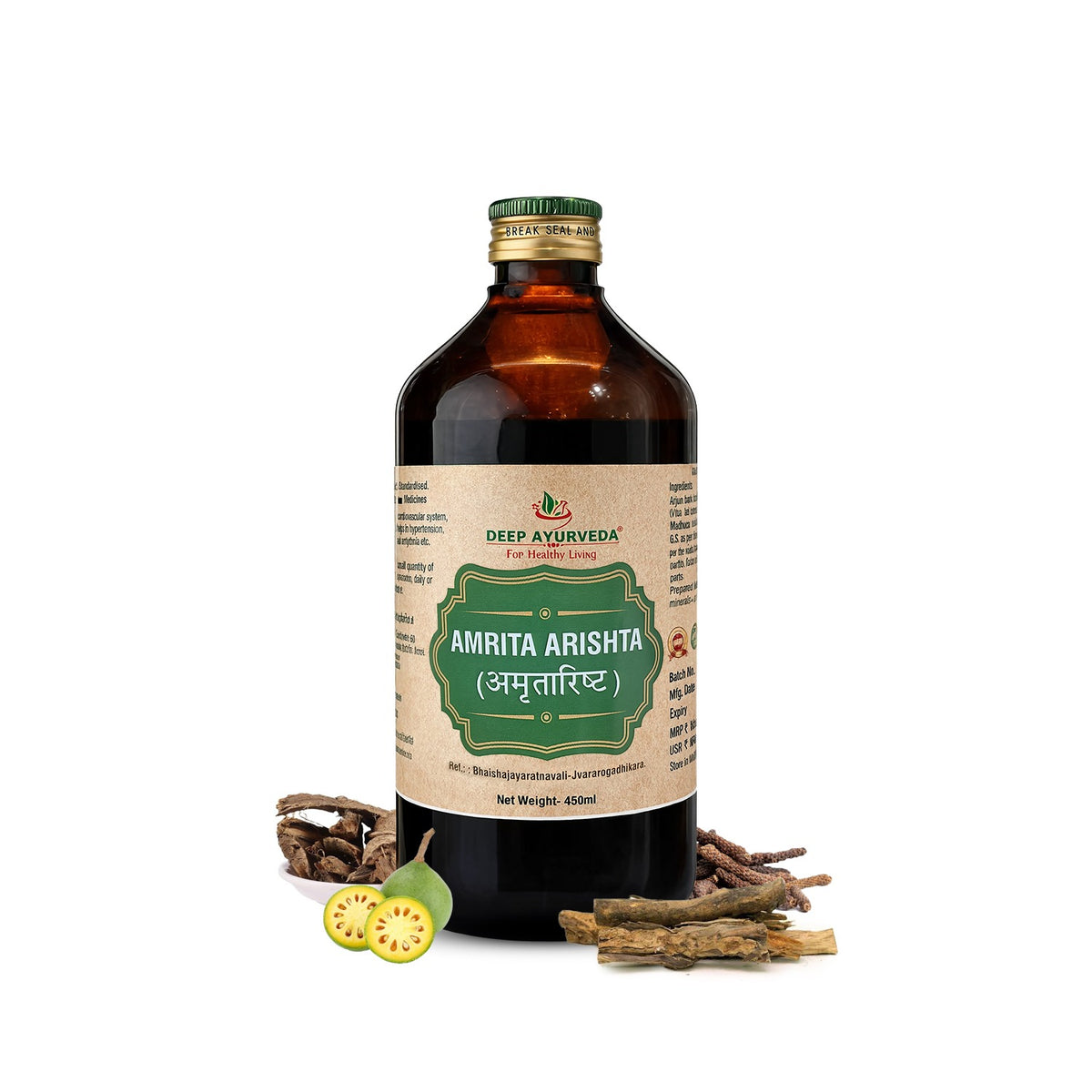
Deep Ayurveda Amritarishta
✅ Supports recovery after fever ✅ Supports immune function ✅ Supports overall energy and strength ✅ May support healthy metabolism ✅ Supports healthy liver function
Introduction
If you've been searching for Amritarishta, you've probably come across many articles describing it as an immunity booster or a remedy for fever. While these descriptions capture part of the picture, they don't explain why Ayurvedic physicians choose Amritarishta, when it's appropriate, or what patients should know before taking it.
As an Ayurvedic doctor, one of the most common questions I hear is:
Doctor, is Amritarishta right for me?
My answer is always the same:
It depends on your body's condition—not just your symptoms.
In Ayurveda, we don't select a medicine solely because someone has a fever, feels tired, or experiences frequent infections. We first understand your constitution (Prakriti), digestive strength (Agni), the presence of Ama (metabolic toxins), and the balance of the three Doshas—Vata, Pitta, and Kapha.
Only after this assessment do we determine whether Amritarishta is the most suitable classical formulation.
Amritarishta has been described in classical Ayurvedic literature as a fermented herbal formulation with Guduchi (Tinospora cordifolia) as its principal ingredient. Guduchi, often called Amrita, literally means nectar in Sanskrit—a reflection of its long-standing reputation in Ayurveda as a Rasayana (rejuvenative) herb. The formulation also contains Dashamoola, digestive herbs, and other botanicals that work together according to traditional Ayurvedic principles.
Unlike single-herb preparations, Amritarishta combines multiple herbs through a natural fermentation process, producing a classical Arishta that has been used traditionally to support recovery, digestive strength, and overall vitality under professional guidance. It naturally contains a small amount of self-generated alcohol created during fermentation, which helps preserve the formulation and may aid the extraction of herbal constituents.
What is Amritarishta?
When patients visit my clinic and ask, Doctor, what exactly is Amritarishta?, I like to begin with a simple explanation.
Amritarishta is a classical Ayurvedic fermented herbal formulation (Arishta) traditionally prepared with Guduchi (Tinospora cordifolia) as its primary ingredient. In Ayurveda, Guduchi is known as Amrita, meaning nectar of immortality, because of its long-standing reputation as a rejuvenating (Rasayana) herb that supports the body's natural balance and vitality.
Unlike herbal tablets or powders, Amritarishta is prepared using a natural fermentation process. During this process, herbs are decocted, combined with sweetening agents and fermentation starters, and allowed to ferment under controlled conditions. This traditional method naturally generates a small amount of self-produced alcohol, which helps preserve the formulation and may improve the extraction of herbal constituents. This is a characteristic feature of classical Arishta preparations and should not be confused with added alcohol.
Understanding Amritarishta from an Ayurvedic Perspective
In Ayurveda, good health depends on maintaining harmony between the three Doshas (Vata, Pitta, and Kapha), a strong Agni (digestive and metabolic fire), balanced body tissues (Dhatus), and the absence of Ama (undigested metabolic waste).
When this balance is disturbed—for example, after recurrent illness, weakened digestion, or reduced vitality—an Ayurvedic physician evaluates the root cause rather than focusing only on symptoms.
In suitable individuals, Amritarishta may be selected as part of a personalized Ayurvedic management plan because its ingredients are traditionally described as supporting:
- Healthy digestive function (Agni)
- Natural detoxification by helping reduce Ama
- Balanced Dosha function according to Ayurvedic principles
- Recovery and rejuvenation (Rasayana)
- Overall strength and well-being
It's important to understand that Ayurveda does not recommend Amritarishta simply because someone has a particular symptom. Two people with similar complaints may receive different formulations based on their constitution (Prakriti), Dosha imbalance, age, digestive capacity, and overall health.
Why is it Called Amritarishta?
The name Amritarishta is derived from two Sanskrit words:
Amrita – Refers to Guduchi (Tinospora cordifolia), a revered Ayurvedic herb traditionally associated with rejuvenation and vitality.
Arishta – A fermented liquid herbal preparation made according to classical Ayurvedic methods.
Together, the name reflects a traditional fermented herbal formulation centered around Guduchi, prepared to support overall health as described in Ayurvedic texts.
What Makes Amritarishta Different from Other Ayurvedic Formulations?
One of the questions I often hear is: Doctor, why not just take Guduchi tablets instead?
This is an excellent question.
While Guduchi is the principal herb in Amritarishta, the formulation is not simply Guduchi in liquid form. It combines Guduchi with several complementary herbs that work together according to Ayurvedic principles. The natural fermentation process also distinguishes it from powders (Churna), decoctions (Kwath), or tablets (Vati).
In Ayurveda, this combination is valued because each ingredient contributes a specific role, creating a formulation designed to work synergistically rather than relying on a single herb alone.
Historical Background & Classical Ayurvedic References
One of the questions patients often ask me is:
Doctor, is Amritarishta a modern herbal supplement or an authentic Ayurvedic medicine?
The answer is simple—Amritarishta is a classical Ayurvedic formulation with a long history in traditional Ayurvedic practice. It is not a recently developed product or a trend-based herbal tonic. Its preparation and therapeutic use are described in respected Ayurvedic compendia that have guided physicians for centuries.
Understanding this background helps us appreciate why Amritarishta continues to be valued in Ayurveda today.
The Classical Origin of Amritarishta
Amritarishta belongs to the Arishta group of Ayurvedic formulations. Arishta preparations are fermented herbal decoctions that are traditionally made using a specific method described in classical Ayurvedic texts.
Unlike modern syrups, these formulations undergo natural fermentation, which enhances preservation and creates a stable liquid preparation without artificial preservatives. The process also helps extract and preserve the active constituents of the herbs according to traditional Ayurvedic pharmaceutics (Bhaishajya Kalpana).
Classical Ayurvedic literature describes Amritarishta with Guduchi (Amrita) as its principal ingredient, supported by other herbs chosen for their complementary actions within Ayurvedic principles.
Why is Guduchi Called Amrita?
The word Amrita in Sanskrit means nectar or that which promotes longevity and vitality.
Guduchi (Tinospora cordifolia) earned this name because Ayurvedic scholars traditionally regarded it as one of the important Rasayana herbs.
In Ayurveda, a Rasayana is not simply an immunity booster. Instead, Rasayana therapy focuses on supporting:
- Healthy ageing
- Balanced body tissues (Dhatus)
- Natural vitality
- Mental and physical well-being
- Recovery after illness
- Long-term maintenance of health
This is why Guduchi occupies a special place in many classical Ayurvedic formulations, including Amritarishta.
Amritarishta in Classical Ayurvedic Literature
The formulation is described in traditional Ayurvedic reference texts and continues to be prepared according to the principles of Bhaishajya Kalpana, the Ayurvedic science of medicine preparation.
These classical texts explain not only the ingredients but also:
- The method of preparation
- The proportion of herbs
- The fermentation process
- Appropriate dosage
- Traditional indications
- Storage recommendations
Even today, reputable Ayurvedic manufacturers prepare Amritarishta by following these traditional principles while complying with modern quality standards.
Why Fermentation is Important in Ayurveda
Many patients become concerned when they learn that Amritarishta is a fermented preparation.
I usually explain it like this:
The fermentation in Amritarishta is a traditional pharmaceutical process—not the same as consuming alcoholic beverages.
During preparation, the herbal decoction is mixed with natural sweetening agents and fermentation initiators. Over time, a small amount of self-generated alcohol develops naturally.
From an Ayurvedic perspective, this process helps:
- Preserve the formulation naturally
- Improve the extraction of herbal constituents
- Enhance shelf stability
- Maintain the therapeutic qualities of the preparation
This method has been practiced in Ayurveda for centuries and remains one of the defining characteristics of Arishta and Asava formulations.
Why Classical Formulations Continue to Be Relevant
A question I often hear in practice is:
Doctor, if Amritarishta is so old, is it still relevant today?
My answer is yes—but with an important clarification.
Ayurveda is not based on replacing classical formulations with newer ones simply because they are old. Instead, it emphasizes selecting the right formulation for the right person at the right time.
Amritarishta remains relevant because its principles are rooted in individualized care. However, it should always be chosen after assessing factors such as:
- Your Prakriti (body constitution)
- Current Dosha imbalance
- Digestive strength (Agni)
- Presence of Ama
- Age
- Lifestyle
- Existing health conditions
This personalized approach is one of the reasons classical Ayurvedic formulations continue to be used in clinical practice today.
How an Ayurvedic Doctor Views Classical Formulations
In my clinical experience, patients sometimes believe that if a formulation has been used traditionally for centuries, it must be suitable for everyone.
This is a common misconception.
Classical Ayurvedic medicines are not meant for self-selection based solely on internet searches or symptoms. They are intended to be prescribed after a comprehensive assessment of the individual's health.
For example, two patients may both complain of fatigue:
- One may have reduced digestive strength (Mandagni) with accumulation of Ama.
- Another may have a predominance of Vata following prolonged stress or inadequate nutrition.
Although the symptom appears similar, the Ayurvedic management plan—and the choice of formulation—may be entirely different.
That is why Ayurveda places greater importance on understanding the root cause than simply matching a medicine to a symptom.
Doctor's Note: The centuries-long use of Amritarishta reflects the enduring principles of Ayurveda, but its traditional value lies in individualized use, not universal use. Consulting a qualified Ayurvedic practitioner helps ensure that the formulation aligns with your constitution, current health status, and overall treatment plan.
Complete Ingredients of Amritarishta and Their Ayurvedic Properties
One of the first questions patients ask after understanding what Amritarishta is:
Doctor, what exactly is inside Amritarishta, and why are so many herbs used instead of just one?
This is an excellent question because Ayurveda rarely depends on a single herb to achieve a therapeutic goal. Instead, classical formulations combine multiple herbs that complement one another and work in harmony according to Ayurvedic principles.
Think of it like an orchestra. While every musician plays a different instrument, they come together to create one balanced performance. In the same way, each herb in Amritarishta has its own traditional role, but together they form a formulation designed to support the body's natural balance.
The exact composition may vary slightly between licensed manufacturers, but the formulation is traditionally centred around Guduchi (Amrita) along with several herbs that support digestion, metabolism, and overall well-being according to Ayurveda.
Main Ingredients in Amritarishta
| Ingredient | Botanical Name | Traditional Ayurvedic Role |
|---|---|---|
| Guduchi (Amrita) | Tinospora cordifolia | Traditionally valued as a Rasayana to support vitality, balanced immunity, and healthy metabolism. |
| Dashamoola | Combination of ten classical roots | Traditionally used to help maintain Vata balance and support recovery. |
| Musta | Cyperus rotundus | Supports healthy digestion and helps maintain digestive balance. |
| Parpataka | Fumaria parviflora / Oldenlandia corymbosa (depending on classical reference) | Traditionally used to support healthy Pitta balance. |
| Ativisha | Aconitum heterophyllum | Traditionally valued for digestive support when used in purified classical formulations. |
| Indrayava | Holarrhena antidysenterica | Supports normal digestive function according to Ayurveda. |
| Shunthi (Dry Ginger) | Zingiber officinale | Helps stimulate Agni (digestive fire) and supports digestion. |
| Maricha (Black Pepper) | Piper nigrum | Traditionally used to enhance digestion and improve the absorption of herbal ingredients. |
| Pippali (Long Pepper) | Piper longum | Supports respiratory and digestive health according to Ayurvedic principles. |
| Jaggery (Guda) | — | Serves as a natural substrate for the traditional fermentation process. |
| Dhataki Flowers | Woodfordia fruticosa | Naturally initiate fermentation and are an important component of classical Arishta preparations. |
Note: The exact ingredient list may differ slightly depending on the manufacturer's adherence to specific Ayurvedic texts and regulatory standards. Always read the product label and consult a qualified Ayurvedic practitioner if you have questions about a particular formulation.
Ayurvedic Properties of Amritarishta
When I explain Ayurvedic medicines to my patients, I often hear this question:
Doctor, how do you know which Ayurvedic medicine is right for me?
Unlike modern medicine, where medicines are often selected based on a diagnosis alone, Ayurveda evaluates the qualities of both the individual and the medicine. Every classical formulation is understood through five important Ayurvedic principles:
- Rasa – Taste
- Guna – Qualities
- Virya – Potency (Heating or Cooling)
- Vipaka – Post-digestive effect
- Dosha Karma – Its influence on Vata, Pitta, and Kapha
These principles help an Ayurvedic physician determine whether a formulation is suitable for a particular individual.
Since Amritarishta is a polyherbal formulation, its overall Ayurvedic properties are understood based on the combined actions of its ingredients rather than a single herb.
Ayurvedic Profile of Amritarishta
| Ayurvedic Parameter | General Ayurvedic Understanding* |
|---|---|
| Rasa (Taste) | Predominantly Tikta (Bitter), Kashaya (Astringent) with secondary Katu (Pungent) notes |
| Guna (Qualities) | Laghu (Light), Ruksha (Dry) |
| Virya (Potency) | Primarily Ushna (Warming) due to the synergistic action of digestive herbs, though some ingredients have cooling properties |
| Vipaka (Post-digestive Effect) | Generally Katu (Pungent) |
| Dosha Karma | Traditionally considered to support the balance of all three Doshas, particularly when used appropriately under Ayurvedic guidance |
How Amritarishta Works According to Ayurveda
One of the most common questions I hear in my clinic is:
Doctor, how does Amritarishta actually work inside the body?
This is an important question because Ayurveda doesn't explain the action of medicines in the same way modern pharmacology does. Instead of focusing on a single organ or symptom, Ayurveda looks at the body's overall balance and how different systems influence one another.
To understand Amritarishta, we first need to understand five key Ayurvedic concepts:
- Agni (Digestive and metabolic fire)
- Ama (Undigested metabolic waste)
- Doshas (Vata, Pitta, and Kapha)
- Dhatus (The body's tissues)
- Ojas (Vital essence associated with overall vitality and resilience)
Rather than targeting one symptom, Amritarishta is traditionally used to support harmony among these interconnected factors.
Step 1: Supporting Healthy Agni (Digestive Fire)
In Ayurveda, Agni is considered the foundation of good health because it governs how efficiently the body digests food, absorbs nutrients, and supports normal metabolism. When Agni becomes weak (Mandagni), digestion may slow down, leading to poor appetite, bloating, heaviness after meals, and reduced energy levels.
Patients with impaired Agni often tell me that they don't feel hungry, experience sluggish digestion, or take longer to recover after an illness. Herbs such as Shunthi (Dry Ginger), Pippali (Long Pepper), and Maricha (Black Pepper) are traditionally included in Amritarishta to support healthy digestive function and help maintain balanced Agni according to Ayurvedic principles.
Step 2: Helping Reduce Ama
According to Ayurveda, when digestion is not functioning properly, the body may accumulate Ama, which refers to incompletely processed metabolic waste. Excess Ama is traditionally believed to interfere with the body's natural balance and may contribute to a feeling of heaviness, reduced appetite, sluggish digestion, and persistent tiredness.
Amritarishta contains herbs that have traditionally been used to support healthy digestion and metabolism, which, from an Ayurvedic perspective, may help the body naturally manage Ama over time. It is important to remember that Ama is an Ayurvedic concept and does not have a direct equivalent in modern medicine.
Step 3: Supporting Balanced Doshas
Every person has a unique combination of the three Doshas—Vata, Pitta, and Kapha, which together regulate different physiological functions. When these Doshas remain in harmony, the body functions efficiently, but factors such as poor diet, stress, seasonal changes, and irregular routines may disturb this balance.
Amritarishta is traditionally used as part of an individualized Ayurvedic approach to help maintain Dosha balance. However, whether it is suitable depends on a person's Prakriti (natural constitution) and Vikriti (current imbalance), which is why two individuals with similar symptoms may receive different Ayurvedic recommendations.
Step 4: Nourishing the Dhatus
Ayurveda explains that the body is sustained by seven Dhatus, or fundamental tissues, which are responsible for nourishment, growth, and overall health. These include Rasa (plasma), Rakta (blood), Mamsa (muscle), Meda (fat tissue), Asthi (bone), Majja (bone marrow and nervous tissue), and Shukra/Artava (reproductive tissue).
When digestion and metabolism function efficiently, these tissues receive proper nourishment. By traditionally supporting healthy Agni and balanced Doshas, Amritarishta is believed to contribute to the natural nourishment and maintenance of the Dhatus as part of a holistic Ayurvedic wellness approach.
Step 5: Supporting Ojas
Patients often ask me, Doctor, what is Ojas? I explain that Ojas is described in Ayurveda as the refined essence produced from healthy digestion and well-nourished body tissues. It is traditionally associated with vitality, physical strength, mental stability, resilience, and overall well-being.
Guduchi, the principal ingredient in Amritarishta, is regarded as a Rasayana herb in Ayurveda. Rather than providing immediate results, Rasayana formulations are traditionally used to support long-term health, vitality, and the maintenance of Ojas when prescribed according to an individual's needs.
Why Amritarishta Is More Than a Fever Medicine
One of the biggest misconceptions I encounter is that Amritarishta is only taken during fever.
In reality, Ayurvedic physicians do not prescribe it simply because someone has a fever.
Instead, we ask questions such as:
- How is your digestion?
- Are you recovering after an illness?
- Is your appetite reduced?
- Do you feel physically weak?
- Is there evidence of Ama according to Ayurvedic assessment?
- What is your Dosha predominance?
Only after evaluating the complete picture do we decide whether Amritarishta is appropriate.
This holistic assessment distinguishes Ayurvedic practice from symptom-based self-medication.
Benefits of Amritarishta: What Does Ayurveda Traditionally Say?
After understanding how Amritarishta works according to Ayurveda, the next question patients usually ask is:
Doctor, what are the actual benefits of Amritarishta?
This is where I encourage patients to think differently.
In Ayurveda, we don't ask, What disease does this medicine treat? Instead, we ask, What imbalance is this formulation traditionally designed to support?
Amritarishta is valued in Ayurveda because it is a classical Rasayana formulation centred around Guduchi (Tinospora cordifolia). Rather than acting on a single symptom, it is traditionally used to support healthy digestion, balanced metabolism, vitality, and the body's natural recovery processes when prescribed appropriately.
The benefits described below are based on traditional Ayurvedic principles. They should not be considered guaranteed outcomes or a substitute for professional medical care. Individual needs vary, so it's always best to consult a qualified Ayurvedic practitioner before using Amritarishta.
1. Traditionally Supports Healthy Immune Function
Guduchi, the primary ingredient in Amritarishta, is traditionally classified as a Rasayana herb in Ayurveda. It is valued for supporting the body's natural resilience and maintaining overall vitality by promoting healthy digestion, balanced Doshas, and nourishing Ojas.
2. Helps Maintain Healthy Digestion and Metabolism
Amritarishta contains digestive herbs such as Shunthi, Pippali, Maricha, and Musta, which are traditionally used to support Agni (digestive fire). Healthy digestion plays an important role in proper nutrient absorption and overall metabolic balance.
3. Traditionally Helps Reduce Ama
According to Ayurveda, impaired digestion may lead to the accumulation of Ama, which is considered a sign of incomplete metabolism. Amritarishta is traditionally used to support healthy digestive function and help the body maintain metabolic balance.
4. Supports Recovery and General Well-being
After prolonged illness or periods of low energy, Ayurvedic physicians may consider Rasayana formulations such as Amritarishta as part of a personalised care plan. It is traditionally used to support vitality, tissue nourishment, and overall well-being during recovery.
5. Helps Maintain Dosha Balance
Amritarishta is traditionally used to help maintain the natural balance of Vata, Pitta, and Kapha when prescribed according to an individual's constitution and current health status. Ayurveda always emphasises personalised treatment rather than a one-size-fits-all approach.
6. Traditionally Supports Healthy Liver and Metabolic Function
Some herbs in Amritarishta are traditionally associated with supporting healthy liver function and efficient metabolism in Ayurveda. These actions contribute to balanced digestion and overall physiological harmony rather than targeting a specific liver condition.
7. Supports the Body's Natural Cleansing Processes
Ayurveda considers healthy digestion and efficient metabolism essential for the body's natural cleansing mechanisms. By supporting Agni and helping maintain Dosha balance, Amritarishta is traditionally used to promote these natural processes.
8. Helps Maintain Energy and Vitality
Healthy digestion is considered the foundation of sustained energy in Ayurveda. When nutrients are properly digested and tissues are adequately nourished, the body is better able to maintain strength, stamina, and day-to-day vitality.
9. Supports Seasonal Wellness
Seasonal changes can influence digestion and Dosha balance. As part of a personalised Ayurvedic regimen, Amritarishta may be recommended to help the body adapt to seasonal transitions while supporting overall wellness.
10. Promotes Holistic Well-being
Unlike formulations that focus on a single body system, Amritarishta is traditionally valued for its holistic approach. Ayurveda considers it a formulation that supports digestion, metabolism, tissue nourishment, and overall balance to promote long-term health.
Traditional Uses of Amritarishta in Ayurveda
After learning about the benefits of Amritarishta, many patients naturally ask me:
Doctor, when do Ayurvedic doctors actually recommend Amritarishta?
This is one of the most important questions because Amritarishta is never prescribed based on a symptom alone. In Ayurveda, the choice of any classical formulation depends on a detailed assessment of your Prakriti (body constitution), Vikriti (current imbalance), Agni (digestive strength), Ama, age, lifestyle, and overall health.
For example, two people may complain of tiredness, but one may have sluggish digestion with Ama accumulation while the other may have Vata imbalance caused by stress and inadequate nourishment. Although the symptom is the same, the Ayurvedic approach—and the medicine chosen—may be completely different.
The following are some of the traditional situations in which an Ayurvedic physician may consider Amritarishta as part of an individualised treatment plan.
Important: The uses described below are based on traditional Ayurvedic principles. They should not be interpreted as claims that Amritarishta can diagnose, treat, cure, or prevent any disease. Always seek professional advice for persistent symptoms or diagnosed medical conditions.
1. During Recovery After Illness
In my practice, I often consider Amritarishta when a patient has recovered from an illness but still experiences reduced appetite, low energy, or general weakness. From an Ayurvedic perspective, recovery is not complete until Agni regains its strength, the Dhatus are properly nourished, and Ojas is restored. When appropriate, Amritarishta may be included alongside suitable diet and lifestyle recommendations to support this recovery phase.
2. To Support Healthy Digestion
Many patients tell me that they feel heavy after meals or have lost their natural appetite. Before recommending any formulation, I carefully assess their digestive capacity and look for signs of Mandagni (reduced digestive fire). Because Amritarishta contains classical digestive herbs such as Shunthi, Pippali, Maricha, and Musta, it is traditionally used to support healthy digestion when it matches the individual's Ayurvedic assessment.
3. When Ama is Present
According to Ayurveda, Ama develops when digestion is inefficient and food is not properly processed. Patients may notice a coated tongue, poor appetite, heaviness, or sluggishness. In these situations, the priority is to improve Agni and gradually reduce Ama before focusing on rejuvenation. Amritarishta may be considered as one part of this personalised approach when clinically appropriate.
4. To Support General Vitality
Irregular eating habits, inadequate sleep, ongoing stress, and a busy lifestyle can gradually affect overall vitality. As a Guduchi-based Rasayana formulation, Amritarishta has traditionally been used to support energy, healthy metabolism, and general well-being. However, it works best when combined with balanced nutrition, proper rest, and healthy daily routines rather than being relied upon as a standalone solution.
5. During Seasonal Changes
Seasonal transitions can influence the balance of the Doshas and affect digestion and energy levels. Some people notice reduced appetite or feel more fatigued during these periods. Depending on the individual's constitution and current health status, an Ayurvedic practitioner may include Amritarishta as part of a seasonal wellness plan along with dietary and lifestyle adjustments.
6. As Part of Rasayana Therapy
Amritarishta is traditionally regarded as a Rasayana formulation, meaning it may be used to support long-term vitality and healthy ageing within Ayurveda. Rasayana therapy is not limited to herbal medicines—it also includes balanced nutrition, restorative sleep, stress management, and healthy daily habits. Amritarishta may form one component of this broader approach when it aligns with the patient's individual needs.
7. As Part of an Individualised Ayurvedic Treatment Plan
One of the defining principles of Ayurveda is that no single formulation is suitable for everyone. Before recommending Amritarishta, I evaluate factors such as the patient's body constitution, Dosha imbalance, digestive strength, lifestyle, stress levels, existing health conditions, and current medications. This detailed assessment helps determine whether Amritarishta is the right choice or whether another classical formulation would be more appropriate.
A Common Misunderstanding About Amritarishta
Many people ask me whether Amritarishta can be taken every day. My answer is that there is no universal recommendation. The appropriate dosage and duration depend on the individual's health condition, digestive capacity, treatment goals, and response to therapy. For this reason, long-term self-medication without professional guidance is not advisable.
Who May Benefit from Amritarishta?
One of the most common questions I hear during consultations is:
Doctor, is Amritarishta suitable for me?
My answer is always the same:
I can't answer that until I understand your body, your digestion, your lifestyle, and your health history.
This may sound surprising, but it reflects one of Ayurveda's most important principles—the same medicine is not suitable for everyone.
Unlike a one-size-fits-all approach, Ayurveda focuses on understanding why you are experiencing a particular health concern before selecting a classical formulation.
For example, two people may both complain of fatigue. One may have poor digestion with Ama accumulation, another may have nutritional deficiencies, while someone else may simply be dealing with chronic stress or an underlying medical condition. Although the symptom is the same, the Ayurvedic approach may be completely different.
That is why an Ayurvedic physician performs a detailed assessment before recommending Amritarishta.
Who May Traditionally Benefit from Amritarishta?
1. People Recovering After an Illness
After recovering from an illness, some people continue to feel weak, lose their appetite, or struggle to regain their normal energy levels. From an Ayurvedic perspective, this may indicate that the digestive fire (Agni) and vitality (Ojas) still need support. In suitable individuals, an Ayurvedic practitioner may consider Amritarishta as part of a personalised recovery plan.
2. Individuals with Reduced Digestive Strength
If you often feel heavy after meals, have a poor appetite, or experience sluggish digestion, your Ayurvedic assessment may point towards Mandagni (reduced digestive fire). Since healthy digestion is considered the foundation of good health in Ayurveda, Amritarishta may be recommended in appropriate cases alongside dietary and lifestyle changes.
3. Individuals Looking to Support Overall Vitality
Long working hours, irregular meals, lack of sleep, and ongoing stress can gradually affect your overall well-being. As a Guduchi-based Rasayana formulation, Amritarishta is traditionally used to support vitality and healthy metabolism, but it works best when combined with healthy daily habits rather than replacing them.
4. People Seeking Seasonal Wellness Support
Seasonal changes can influence digestion, appetite, and energy levels. Depending on your body constitution and the season, an Ayurvedic practitioner may recommend Amritarishta as part of a broader plan that includes seasonal dietary adjustments and lifestyle modifications.
5. Adults Following an Ayurvedic Wellness Plan
Some people consult an Ayurvedic doctor not because they are unwell, but because they want to maintain long-term health. After evaluating factors such as digestion, sleep, stress levels, and body constitution, Amritarishta may be included in a personalised wellness programme if it aligns with the individual's needs.
Who Should Use Extra Caution?
One of the biggest misconceptions is that natural always means safe. In reality, every herbal formulation should be selected according to an individual's age, health condition, and medical history. Before using Amritarishta, extra care is recommended in the following situations.
Pregnant or Breastfeeding Women
The safety of Amritarishta during pregnancy or breastfeeding should always be discussed with a qualified healthcare professional. Self-medication during these important stages of life is not recommended.
Children
Children have different nutritional and physiological needs than adults. Their age, digestive capacity, and overall health should be carefully assessed before any classical Ayurvedic formulation, including Amritarishta, is considered.
Older Adults
Older adults may have multiple health conditions or be taking prescription medicines. For this reason, the suitability and dosage of Amritarishta should always be determined on an individual basis.
People Living with Chronic Medical Conditions
If you have a long-term medical condition such as diabetes, heart disease, kidney disease, liver disease, or an autoimmune disorder, consult both your healthcare provider and an Ayurvedic practitioner before taking Amritarishta. This helps ensure your overall treatment plan remains safe and well coordinated.
Individuals Taking Prescription Medicines
If you regularly take prescription medicines or dietary supplements, let your Ayurvedic practitioner know before starting Amritarishta. Sharing this information helps them make informed decisions and reduce the possibility of unwanted interactions.
Who May Need a Different Ayurvedic Formulation?
One of the most valuable lessons Ayurveda teaches is that there is no universal medicine for every person.
During consultations, there are many occasions when I decide not to recommend Amritarishta because another classical formulation is more suitable for the patient's Dosha imbalance, digestive condition, or overall health goals.
For example, if the underlying imbalance is different, I may recommend another classical preparation. This is also why I encourage patients not to choose Ayurvedic medicines simply because they read about them online or someone else found them helpful.
When Should You Seek Immediate Medical Care?
Although Ayurveda plays an important role in supporting overall health and recovery, it should never delay emergency medical treatment.
Seek immediate medical attention if you experience symptoms such as persistent high fever, difficulty breathing, chest pain, severe dehydration, sudden confusion, loss of consciousness, persistent vomiting, blood in the vomit or stool, or any other rapidly worsening symptoms.
Once urgent medical concerns have been appropriately managed, Ayurvedic care may be integrated into your overall treatment plan where suitable.
Dosage of Amritarishta: How Much Should You Take?
One of the first questions patients ask after deciding to use Amritarishta is:
Doctor, how much should I take, and when is the best time to take it?
This is an important question because taking the correct dosage is just as important as choosing the right medicine.
In my clinical practice, I never recommend the same dosage to every patient. Before advising Amritarishta, I assess factors such as the person's age, digestive strength (Agni), body constitution (Prakriti), current Dosha imbalance, overall health, and the reason for using the formulation. I also review any existing medical conditions and medicines the patient may already be taking.
For this reason, the information below should be considered general guidance rather than a personalised prescription.
Recommended Dosage of Amritarishta
For most healthy adults, the commonly recommended dosage is 15–30 ml, usually diluted with an equal quantity of lukewarm water and taken twice daily after meals, or as advised by a qualified Ayurvedic practitioner.
For children, Amritarishta should only be given under the supervision of an Ayurvedic physician. The dosage depends on the child's age, weight, digestive capacity, and individual health condition.
Note: Always read the dosage instructions on the product label, as recommendations may vary slightly between manufacturers.
Why is Amritarishta Usually Taken After Meals?
Patients often ask me,
Can I take Amritarishta on an empty stomach?
In most cases, I recommend taking it after meals, as this is the traditional practice for many classical Arishta formulations. Taking it after food may support comfortable digestion and reduce the chances of stomach irritation in people with a sensitive digestive system.
However, there can be exceptions. Depending on your health condition and treatment plan, your Ayurvedic practitioner may suggest a different schedule.
Should Amritarishta Be Mixed with Water?
Yes. Traditionally, Amritarishta is diluted with an equal quantity of lukewarm water before consumption.
For example, if you're taking 15 ml of Amritarishta, you can mix it with 15 ml of lukewarm water. Similarly, 20 ml can be mixed with 20 ml of water, and 30 ml with 30 ml of water.
This simple step makes the formulation easier to consume and follows the traditional Ayurvedic method of administration.
How Long Should You Take Amritarishta?
Another question I frequently hear is:
Doctor, for how many days should I continue taking it?
There isn't a fixed answer because the duration varies from person to person.
Some patients may need it only for a short period, while others may be advised to continue it for longer under regular supervision. The decision depends on your health goals, Ayurvedic assessment, response to the formulation, and whether other therapies are also part of your treatment plan.
Rather than continuing any classical medicine indefinitely, I prefer reviewing my patients periodically and adjusting the treatment plan based on their progress.
What Should You Do If You Miss a Dose?
If you occasionally miss a dose, don't worry.
Simply take the next scheduled dose at the usual time. Avoid taking a double dose to make up for the missed one, as more medicine doesn't necessarily provide better results.
If missing doses becomes a regular habit, it's worth discussing with your practitioner so that together you can create a routine that's easier to follow.
Can You Take Amritarishta Every Day?
Many patients ask,
Doctor, can I take Amritarishta every day?
The answer depends entirely on why it has been recommended.
Some individuals may be advised to take it daily for a specific period, while others may require a different dosage schedule or even a different formulation altogether. This decision should always be based on an Ayurvedic assessment rather than a general recommendation found online.
Can You Take Amritarishta Along with Other Ayurvedic Medicines?
Yes, it can sometimes be prescribed alongside other Ayurvedic formulations, but this should always be done under professional guidance.
In clinical practice, I may combine Amritarishta with a Kwath, Churna, Vati, or another classical formulation if it complements the patient's overall treatment plan. The combination is chosen according to the individual's constitution, Dosha imbalance, and therapeutic goals—not because there is one standard combination that suits everyone.
Is Amritarishta Safe?
Amritarishta is a classical Ayurvedic fermented formulation that has been used in traditional practice for generations. When prepared according to recognised Ayurvedic standards and taken in the recommended dosage under the supervision of a qualified Ayurvedic practitioner, it is generally considered suitable for many adults.
However, Ayurveda does not believe that one medicine is appropriate for everyone. Before recommending Amritarishta, I always assess several important factors, including your age, body constitution (Prakriti), current Dosha imbalance, digestive strength (Agni), existing medical conditions, pregnancy or breastfeeding status, and any medicines or supplements you are already taking. This personalised assessment helps determine whether the formulation is appropriate for your individual needs.
Possible Side Effects of Amritarishta
Most people who take Amritarishta correctly do not experience significant side effects. However, as with any herbal or conventional medicine, individual responses can vary.
Mild Stomach Discomfort
Some individuals, particularly those with a sensitive digestive system, may notice mild stomach discomfort when they first start taking Amritarishta. Taking it after meals and in the recommended quantity may help improve comfort.
Digestive Upset
In some cases, temporary digestive changes such as bloating or mild abdominal discomfort may occur. These symptoms are often influenced by an individual's digestive capacity and overall health rather than the formulation alone.
Feeling of Warmth
Because Amritarishta contains herbs that traditionally support digestion and metabolism, some people may experience a mild sensation of warmth after taking it. This does not occur in everyone and usually depends on individual constitution.
Loose Stools
Sensitive individuals may occasionally notice softer stools, especially if the formulation is taken in larger amounts than recommended. If this continues, it is advisable to consult your Ayurvedic practitioner.
Nausea
Taking Amritarishta on an empty stomach or using it without professional guidance may cause nausea in some people. Following the recommended dosage and timing may help reduce this possibility.
If any of these symptoms become persistent, severe, or concerning, discontinue the formulation and seek advice from your healthcare provider or qualified Ayurvedic practitioner.
Why Can Side Effects Occur?
Patients often ask,
Doctor, if this is a classical Ayurvedic medicine, why would anyone experience side effects?
In my clinical experience, side effects are more often related to how the medicine is used rather than the medicine itself.
Incorrect Self-Diagnosis
Many people begin taking Amritarishta after reading online about its benefits without understanding whether it matches their body constitution or current Ayurvedic imbalance. A formulation that suits one person may not necessarily suit another.
Taking More Than the Recommended Dose
Some individuals believe that increasing the dosage will produce quicker results. However, Ayurveda emphasises using the appropriate dose for the individual rather than taking larger quantities.
Poor Digestive Strength
If your digestive fire (Agni) is already weak, your Ayurvedic practitioner may first recommend improving digestion before introducing a Rasayana formulation like Amritarishta. This step helps ensure the medicine is used appropriately.
Poor Product Quality
The quality of herbal medicines can vary between manufacturers. Choosing products from trusted brands that follow recognised quality standards and Good Manufacturing Practices (GMP) can help ensure consistency and safety.
Who Should Take Extra Precautions?
Although Amritarishta has been used in Ayurveda for centuries, some individuals should seek professional advice before using it.
Pregnant Women
If you are pregnant or planning a pregnancy, avoid starting Amritarishta without first consulting both your obstetrician and a qualified Ayurvedic practitioner. Individual assessment is essential during pregnancy.
Breastfeeding Mothers
The suitability of Amritarishta while breastfeeding depends on your overall health and should be discussed with a healthcare professional before use.
Children
Classical Ayurvedic formulations should only be given to children after an appropriate clinical evaluation. The dosage and suitability depend on the child's age, weight, digestive capacity, and health condition.
Older Adults
Older adults are more likely to have age-related health conditions or use multiple medications. For this reason, an individual assessment helps determine whether Amritarishta is appropriate and whether any dosage adjustments are required.
People Living with Chronic Medical Conditions
If you have a chronic health condition such as diabetes, liver disease, kidney disease, heart disease, or an autoimmune disorder, consult your healthcare provider before starting Amritarishta. Coordinating Ayurvedic and conventional medical care helps ensure safe and appropriate treatment.
Does Amritarishta Contain Alcohol?
Yes, Amritarishta naturally contains a small amount of self-generated alcohol produced during the traditional fermentation process. This alcohol is not added separately like alcoholic beverages. Instead, it develops naturally and helps preserve the formulation while supporting the extraction of herbal constituents according to classical Ayurvedic pharmaceutics.
If you avoid alcohol for medical, religious, or personal reasons, discuss this with your Ayurvedic practitioner before using the formulation.
Can Amritarishta Interact with Medicines?
If you are taking prescription medicines, over-the-counter medicines, herbal supplements, vitamins, or nutritional supplements, inform your healthcare provider before starting Amritarishta. Sharing this information allows your healthcare team to assess your overall treatment plan and provide personalised advice.
When Should You Stop Taking Amritarishta?
If you experience persistent stomach discomfort, severe digestive symptoms, signs of an allergic reaction such as rash or swelling, severe vomiting, or a noticeable worsening of your symptoms, stop taking Amritarishta and seek medical advice promptly. If you develop severe or emergency symptoms, seek immediate medical care.
How Can You Reduce the Risk of Side Effects?
The best way to minimise the risk of side effects is to use Amritarishta only after a proper Ayurvedic assessment and to follow the dosage recommended by your practitioner or the product label. Always choose products from reputable manufacturers, attend follow-up consultations if using the formulation for a longer period, and let your practitioner know about any medicines or supplements you are taking. Paying attention to your body's response and reporting any unexpected symptoms early can also help ensure safe use.
Frequently Asked Questions
1. What is Amritarishta used for?
Amritarishta is a classical Ayurvedic fermented formulation traditionally used to support healthy digestion (Agni), balanced Doshas, overall vitality (Ojas), and recovery after illness. In Ayurveda, it is prescribed based on an individual's constitution, digestive health, and overall clinical assessment rather than symptoms alone.
2. How should I take Amritarishta?
Adults are commonly advised to take 15–30 ml of Amritarishta mixed with an equal quantity of lukewarm water, usually twice daily after meals, or as directed by a qualified Ayurvedic practitioner. Always follow the dosage instructions on the product label or your healthcare provider's advice.
3. Can I take Amritarishta every day?
The duration and frequency of use depend on your individual health condition, Ayurvedic diagnosis, and treatment goals. Some people may be advised to take it daily for a specific period, while others may require a different regimen. It is best used under the supervision of a qualified Ayurvedic practitioner.
4. Does Amritarishta contain alcohol?
Yes. Amritarishta naturally contains a small amount of self-generated alcohol formed during the traditional fermentation process. This alcohol is not added separately and helps preserve the formulation while supporting the extraction of herbal constituents.
5. Are there any side effects of Amritarishta?
When taken in the recommended dosage under professional guidance, Amritarishta is generally well tolerated. However, some individuals may experience mild digestive discomfort or stomach upset depending on their constitution or underlying health condition. If you notice any persistent or unusual symptoms, discontinue use and consult your healthcare provider.
6. Can pregnant or breastfeeding women take Amritarishta?
Pregnant or breastfeeding women should only take Amritarishta after consulting their healthcare provider and a qualified Ayurvedic practitioner. Self-medication during pregnancy or breastfeeding is not recommended.
7. Can Amritarishta replace conventional medical treatment?
No. Amritarishta should not replace prescribed medical treatment or delay professional medical care. It is a traditional Ayurvedic formulation that may be used as part of a personalised healthcare plan under the guidance of qualified healthcare professionals.
Conclusion
Amritarishta is more than a traditional Ayurvedic formulation—it reflects Ayurveda's holistic philosophy of restoring balance through personalised care. Rather than viewing it as a universal remedy, it should be understood as a classical preparation that may support digestion, metabolism, vitality, and overall wellness when used appropriately.
If you're exploring Ayurvedic care, remember that the most effective treatment is not the one that is most popular online, but the one that is most appropriate for your individual constitution and health needs. A consultation with a qualified Ayurvedic practitioner can help determine whether Amritarishta fits into your personalised wellness plan and how it can be used safely alongside a healthy lifestyle.