

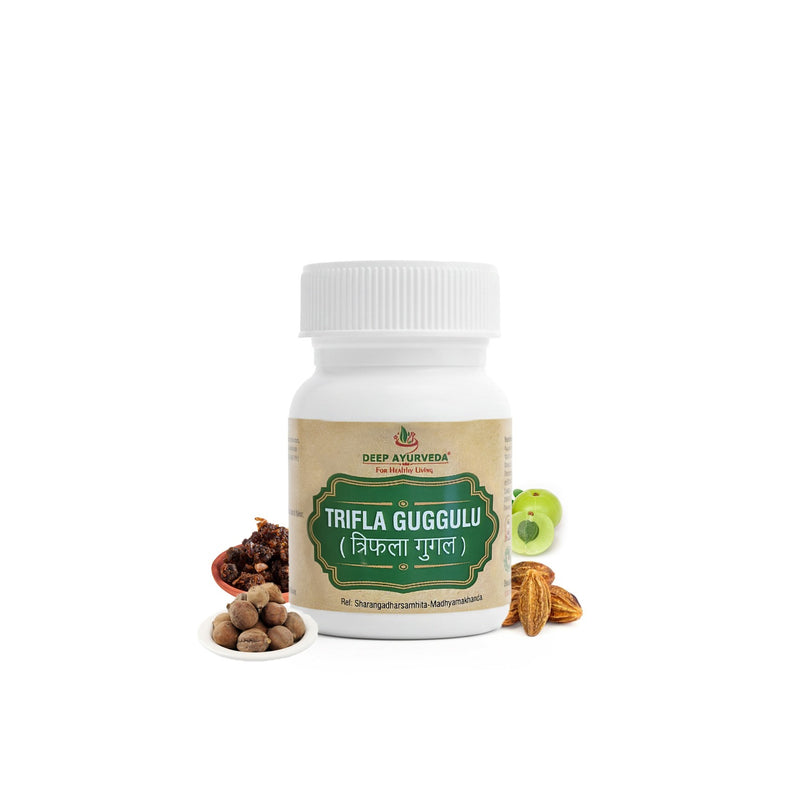
Deep Ayurveda Triphala Guggulu
✅ Supports Healthy Digestion ✅ Supports Metabolic Health ✅ Promotes Healthy Skin ✅ Supports Natural Detoxification ✅ Supports Overall Ayurvedic Balance ✅ Easy to Use
Triphala Guggulu is a classical Ayurvedic formulation made with Haritaki, Bibhitaki, Amalaki, Pippali and Shuddha Guggulu. Traditionally, it is used in selected Ayurvedic conditions such as Arsha, Bhagandara, Nadi Vrana, Gulma and Shotha. Its use and dosage depend on the individual's condition rather than being a one-size-fits-all remedy.
Unlike ordinary Triphala, Triphala Guggulu combines the three fruits of Triphala with Pippali and purified Guggulu, giving the formulation a different Ayurvedic profile. In this guide, we will look at its ingredients, traditional uses, potential benefits, dosage, precautions and what should be understood before using it.
Important: Ayurvedic medicines should not automatically be considered risk-free simply because they are natural. The Ministry of AYUSH's pharmacovigilance programme specifically emphasizes responsible use and monitoring of adverse reactions.
What Is Triphala Guggulu?
Triphala Guggulu is a traditional Guggulu-based Ayurvedic formulation containing five principal ingredients:
- Haritaki (Terminalia chebula)
- Bibhitaki (Terminalia bellirica)
- Amalaki (Phyllanthus emblica)
- Pippali (Piper longum)
- Shuddha Guggulu (Commiphora wightii)
The first three ingredients make up Triphala, while Pippali and purified Guggulu give the formulation its distinct therapeutic character.
From an Ayurvedic perspective, it is not simply a combination of five herbs chosen randomly. The formulation brings together ingredients traditionally associated with Agni, digestion, bowel function, Shodhana-oriented actions and management of certain inflammatory or obstructive presentations.
The classical Ayurvedic indications are more specific than the broad claims often seen on commercial websites. Government AYUSH material lists Triphala Guggulu among formulations used for conditions including Arsha (piles), Bhagandara, Nadi Vrana, Gulma and Shotha
Why Is Triphala Guggulu Different From Triphala?
This is an important distinction.
Triphala contains only Haritaki, Bibhitaki and Amalaki. It is commonly used in Ayurveda in contexts related to digestion, bowel regularity and Rasayana-oriented care.
Triphala Guggulu, on the other hand, adds Pippali and Shuddha Guggulu, creating a substantially different formulation.
Therefore, the two should not be treated as interchangeable simply because they share the word Triphala.
Triphala Guggulu Ingredients
Each ingredient has its own traditional Ayurvedic role.
| Ingredient | Botanical name | Traditional Ayurvedic relevance |
|---|---|---|
| Haritaki | Terminalia chebula | Traditionally associated with bowel regulation and Vata-related management |
| Bibhitaki | Terminalia bellirica | Traditionally used in Kapha-related and respiratory/digestive contexts |
| Amalaki | Phyllanthus emblica | Traditionally valued for Pitta balance and Rasayana applications |
| Pippali | Piper longum | Traditionally associated with Deepana and Pachana |
| Shuddha Guggulu | Commiphora wightii | Traditionally used in formulations addressing Shotha and metabolic/obstructive conditions |
Interestingly, the classical formulation is not simply an equal blend of these ingredients. The formulation ratio gives greater quantity to Guggulu, which is an important clue to its distinct therapeutic identity.
The Role of Pippali
Pippali is traditionally described as Deepana and Pachana, meaning it is used in Ayurvedic practice in contexts where supporting digestive capacity and metabolism is considered important.
The National Medicinal Plants Board also records traditional uses of Piper longum in digestive and inflammatory contexts.
The Role of Shuddha Guggulu
Guggulu is the resinous material obtained from Commiphora wightii. In classical Ayurvedic pharmaceutical practice, Shuddha Guggulu is used rather than simply treating raw resin as the finished medicinal ingredient.
This distinction matters because Ayurvedic formulations are based not only on the identity of an ingredient but also on how the ingredient is processed and combined.
Ayurvedic Properties of Triphala Guggulu
To understand Triphala Guggulu properly, it helps to look beyond a simple benefits list.
An Ayurvedic practitioner may consider factors such as:
- Agni – digestive/metabolic capacity
- Ama – improperly processed metabolic material in the Ayurvedic framework
- Dosha involvement
- Mala – especially bowel function
- Srotas – channels/pathways
- Shotha – swelling/inflammatory presentation
- The patient's Prakriti and Vikriti
This is one reason the same formulation may be appropriate for one person but unsuitable for another.
A medicine's traditional indication does not mean that everyone experiencing a similar symptom should self-prescribe it.
Triphala Guggulu Benefits
The benefits discussed below should be understood in the context of traditional Ayurvedic use, not as a guarantee that the formulation will treat or cure a particular disease.
1. Supports Healthy Bowel Function
The Triphala component has a long history of use in Ayurveda in formulations concerned with bowel regularity.
Haritaki, in particular, is traditionally valued for supporting proper bowel movement. When bowel habits are affected by dietary factors, low digestive strength or irregular routines, Ayurvedic practitioners may consider Triphala-based formulations depending on the individual's presentation.
However, persistent constipation should not simply be managed indefinitely with self-medication.
2. Traditionally Used for Arsha (Piles)
Arsha is the Ayurvedic term commonly translated in relation to piles/hemorrhoidal conditions.
Triphala Guggulu has a classical association with Arsha, which is one reason it remains a commonly discussed Ayurvedic formulation for piles.
From a practitioner's perspective, however, it is important to identify the underlying pattern. Constipation, straining, diet, bowel habits and the nature of bleeding all matter.
Rectal bleeding should never automatically be assumed to be piles. Persistent or unexplained bleeding requires appropriate medical evaluation.
3. Traditionally Used in Bhagandara
Bhagandara is an important classical Ayurvedic indication associated with an abnormal tract around the anal region and is commonly compared with fistula-in-ano.
Triphala Guggulu is traditionally mentioned in this context.
But this does not mean someone with a suspected anal fistula should rely on tablets alone. Fistula can require proper clinical assessment and, depending on the condition, surgical management.
4. Supports Healthy Digestion
Pippali and the Triphala ingredients give the formulation a traditional connection with Agni and digestion.
In Ayurveda, digestion is not viewed only as the ability to digest a meal. The quality of Agni is considered important for the formation of healthy tissues and proper elimination.
Therefore, an Ayurvedic practitioner may look at symptoms such as:
- heaviness after eating
- irregular appetite
- bloating
- bowel irregularity
- sluggish digestion
before deciding whether a formulation is appropriate.
5. Traditionally Used in Shotha
Shotha is an Ayurvedic term broadly associated with swelling or inflammatory-type presentations.
Triphala Guggulu is traditionally included among formulations used in this context.
However, swelling can have many different causes. New, severe or unexplained swelling should be medically evaluated rather than automatically attributed to an Ayurvedic dosha imbalance.
6. May Be Considered in Certain Metabolic Health Contexts
This is an area where online content often becomes exaggerated.
You may see claims that Triphala Guggulu burns fat, melts belly fat or guarantees weight loss. Such claims are too simplistic.
The Ministry of AYUSH's Standard Treatment Guidelines for metabolic disorders include Triphala Guggulu at 1–3 g, morning and evening, for 15–30 days with lukewarm water in a specified clinical context.
That is very different from claiming that Triphala Guggulu is a universal weight-loss medicine.
In Ayurvedic practice, management of metabolic concerns also involves Ahara, physical activity, sleep, digestive status and the individual's overall presentation.
How Does Triphala Guggulu Work According to Ayurveda?
This is where the formulation becomes particularly interesting.
Rather than looking at each ingredient separately, Ayurveda considers the combined action of the formulation.
Triphala
The three fruits provide the foundational Triphala component and are traditionally associated with digestive and elimination-related functions.
Pippali
Pippali contributes a traditionally Deepana-Pachana orientation and is often considered when digestion and metabolic processing need attention.
Guggulu
Guggulu contributes a different therapeutic dimension and is traditionally used in formulations addressing Shotha and certain metabolic or obstructive presentations.
Therefore, Triphala Guggulu should not be understood simply as:
Triphala + something extra.
It is a distinct classical formulation with its own therapeutic rationale.
How to Take Triphala Guggulu?
There is no single dosage that is appropriate for every individual or every condition.
The dose can depend on:
- the reason for use
- age
- digestive strength
- constitution
- severity and duration of symptoms
- other medicines being taken
- the specific formulation and manufacturer
Government AYUSH guidance gives different dosing contexts. For example, its metabolic-disorder guideline lists 1–3 g twice daily for 15–30 days with lukewarm water for a specified clinical application.
This should not be interpreted as a universal self-treatment dose for every person.
Best Time to Take Triphala Guggulu
The timing can vary according to the therapeutic purpose and practitioner's assessment.
Some Ayurvedic treatment protocols use it around meals, while others may use a specific timing and Anupana according to the condition.
Therefore, if you are using Triphala Guggulu for a particular health condition, following the dosage and timing recommended by a qualified Ayurvedic practitioner is preferable to copying a generic internet dosage.
Triphala Guggulu Side Effects
Natural does not automatically mean free from side effects.
The Ministry of AYUSH's pharmacovigilance programme specifically notes the importance of monitoring adverse reactions to AYUSH medicines and challenges the misconception that natural medicines are always safe.
Depending on the individual and dosage, digestive intolerance may occur.
Possible concerns can include:
- loose stools
- abdominal discomfort
- digestive irritation
- intolerance to the formulation
If symptoms are persistent, severe or unusual, stop self-treatment and seek appropriate professional advice.
Who Should Avoid Triphala Guggulu?
Extra caution is appropriate for:
- pregnant women
- people with chronic or recurrent diarrhoea
- people with significant digestive sensitivity
- people taking multiple prescription medicines
- people with ongoing medical conditions
- people with unexplained rectal bleeding
Pregnancy and chronic/recurrent diarrhoea are specifically identified as precautions in AYUSH material for Triphala Guggulu.
If you are already taking medicines for a chronic condition, discuss the use of Triphala Guggulu with your treating physician or qualified Ayurvedic practitioner before starting it.
Triphala Guggulu for Piles: Can You Take It Yourself?
This is one of the most important questions to answer responsibly.
If someone has occasional constipation and has previously been medically evaluated for uncomplicated hemorrhoids, an Ayurvedic practitioner may consider Triphala Guggulu depending on the individual's presentation.
But rectal bleeding should not automatically be diagnosed as piles.
Seek medical evaluation if there is:
- repeated or heavy bleeding
- severe pain
- a new lump
- unexplained weight loss
- persistent change in bowel habits
- fever
- pus or discharge
- symptoms that keep returning
The goal of Ayurveda should not be to delay a necessary diagnosis.
Triphala Guggulu vs Triphala
Although the names are similar, they are not the same formulation.
| Feature | Triphala | Triphala Guggulu |
|---|---|---|
| Main ingredients | Haritaki, Bibhitaki, Amalaki | Triphala + Pippali + Shuddha Guggulu |
| Formulation | Triphala preparation | Guggulu-based formulation |
| Traditional focus | Digestive, bowel and Rasayana-related uses | More specific classical indications |
| Guggulu present | No | Yes |
| Pippali present | No | Yes |
So, choosing between the two should depend on the intended therapeutic purpose, not simply on which product has more ingredients.
What Does Modern Research Say About Triphala Guggulu?
This is an area where readers deserve an honest answer.
There is research involving Triphala Guggulu and its individual ingredients, but the amount and quality of evidence varies depending on the condition being investigated.
A clinical study involving Triphala Guggulu has investigated its use in the context of bleeding piles, while Ayurvedic treatment guidelines also include the formulation in specific clinical contexts.
However, evidence involving an individual ingredient should not automatically be presented as proof that the complete Triphala Guggulu formulation will produce the same result.
That distinction is important.
What we can reasonably say
Ayurveda: Triphala Guggulu has established traditional uses and classical indications.
Modern research: Some studies have investigated the formulation and its ingredients.
What remains uncertain: More high-quality, well-designed clinical research is needed to establish effectiveness for many of the broad health claims commonly made online.
This evidence-aware approach is preferable to presenting every traditional claim as a clinically proven fact.
When Should You Consult a Doctor?
Do not rely on self-treatment if you experience:
- persistent or unexplained rectal bleeding
- severe abdominal or anal pain
- unexplained weight loss
- persistent constipation
- recurrent diarrhoea
- fever
- pus or abnormal discharge
- symptoms that continue despite lifestyle changes
- symptoms that suddenly become worse
For suspected fistula, significant bleeding or persistent gastrointestinal symptoms, professional evaluation is particularly important.
Final Thoughts
Triphala Guggulu is more than a combination of Triphala and Guggulu. It is a classical Ayurvedic formulation with a specific therapeutic rationale and traditional indications.
Its ingredients—Haritaki, Bibhitaki, Amalaki, Pippali and Shuddha Guggulu—bring different Ayurvedic properties together. While traditional Ayurveda gives the formulation an important place in selected conditions, responsible use means understanding the indication, dosage, individual suitability and safety considerations rather than treating it as a universal remedy.
For health conditions such as persistent bleeding, suspected fistula, chronic constipation or unexplained pain, proper diagnosis should always come before self-treatment.
Frequently Asked Questions About Triphala Guggulu
What is Triphala Guggulu used for?
Triphala Guggulu is a classical Ayurvedic formulation traditionally used in conditions including Arsha, Bhagandara, Nadi Vrana, Gulma and Shotha.
What are the main ingredients of Triphala Guggulu?
It contains Haritaki, Bibhitaki, Amalaki, Pippali and Shuddha Guggulu.
Is Triphala Guggulu the same as Triphala?
No. Triphala contains Haritaki, Bibhitaki and Amalaki, while Triphala Guggulu additionally contains Pippali and Shuddha Guggulu.
Can Triphala Guggulu help with constipation?
It may be considered in selected Ayurvedic presentations involving bowel irregularity, but chronic constipation requires assessment of the underlying cause.
Is Triphala Guggulu traditionally used for piles?
Yes. Arsha is one of its classical Ayurvedic indications.
Can Triphala Guggulu be used for weight loss?
It is included in some Ayurvedic metabolic-management guidelines, but it should not be marketed or understood as a guaranteed weight-loss medicine.
What is the dosage of Triphala Guggulu?
Dosage depends on the indication and individual. AYUSH guidance gives specific doses for specific clinical contexts rather than one universal dose.
Can Triphala Guggulu cause side effects?
Digestive intolerance, including loose stools or abdominal discomfort, may occur in some individuals. Any persistent or significant adverse effect should be discussed with a healthcare professional.
Who should avoid Triphala Guggulu?
Pregnant individuals and people with chronic or recurrent diarrhoea require particular caution. People taking medicines or managing chronic conditions should seek professional guidance before use.
Can I take Triphala Guggulu long term?
Long-term use should not be decided solely from an internet article. The appropriate duration depends on the indication, dose, response and individual assessment.


1 Comment
Thank you immensely for providing this comprehensive guide! It was incredibly helpful, and as a result, I was relieved to receive my recent blood work results, which indicated that the HSV virus was not detected Email ituahealer@gmail.com