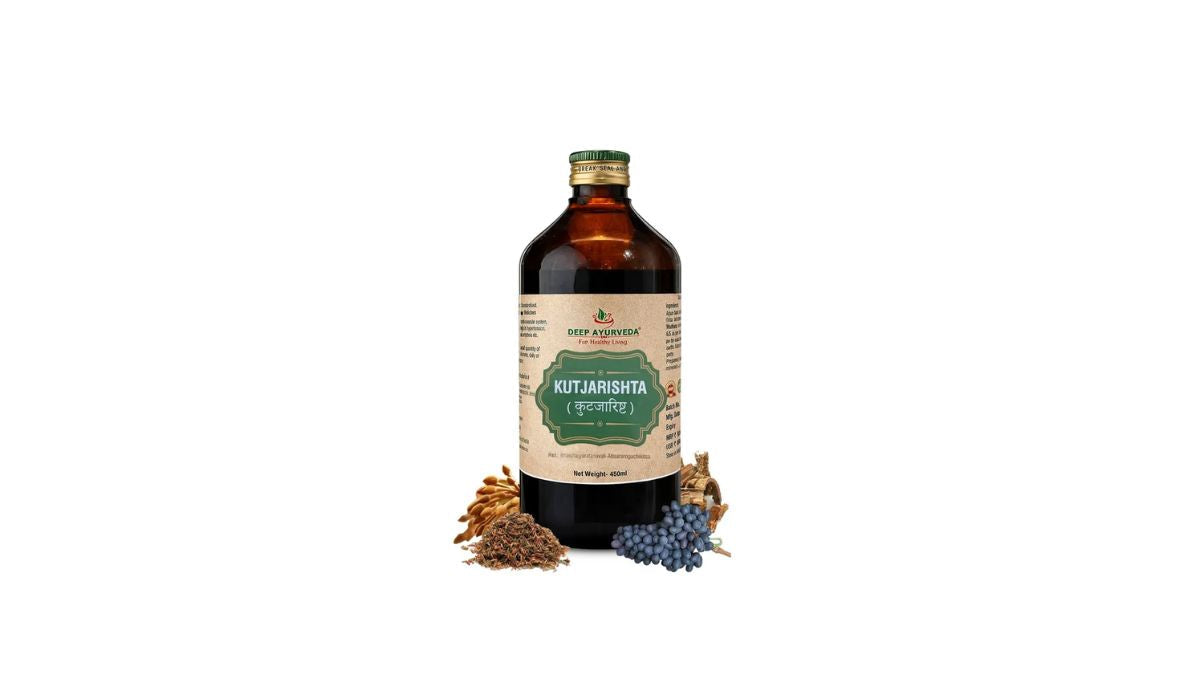

Deep Ayurveda Kutajarishta
✅ Supports Healthy Bowel Function ✅ Helps Manage Loose Stools ✅ Supports Digestive Health ✅ May Support Appetite ✅ Supports a Healthy Gut Environment
Loose motions, frequent bowel movements, digestive weakness or recurrent bowel disturbances can be frustrating—especially when the same digestive problem keeps returning despite temporary relief.
In Ayurveda, however, every episode of loose stool is not viewed in exactly the same way. The nature of the stool, digestion, appetite, abdominal discomfort, Dosha involvement, duration of the problem and the presence of Ama all help an Ayurvedic physician understand the condition before selecting a formulation.
Kutajarishta is one such classical Ayurvedic fermented formulation traditionally associated with Atisara and related digestive disorders. Its principal herb, Kutaja, has been valued in Ayurvedic medicine for its Grahi and Kashaya-oriented properties.
But there is an important point that is often missed in online articles: Kutajarishta should not simply be thought of as a medicine that “stops loose motion.” Ayurveda looks at why bowel disturbance has occurred and whether the person's digestive condition is suitable for a Grahi formulation.
In this guide, we will look at Kutajarishta from both a classical Ayurvedic and practical health perspective, including its ingredients, traditional uses, dosage, fermentation process, possible side effects, precautions, its role in Atisara and Grahani, and how it differs from other Ayurvedic digestive formulations.
Doctor's Note: Ayurvedic formulations should be selected according to the individual's condition. Persistent diarrhoea, blood in the stool, severe abdominal pain, high fever or signs of dehydration require appropriate medical evaluation rather than relying on self-medication.
What Is Kutajarishta?

Kutajarishta, also known as Kutajarishtam, is a classical Ayurvedic fermented liquid formulation in which Kutaja is the principal medicinal ingredient.
Kutaja is botanically associated with the Holarrhena genus and has a long history of use in Ayurveda, particularly in conditions involving disturbed bowel function.
The word Arishta refers to a category of Ayurvedic fermented preparations. Unlike a simple herbal decoction or powder, an Arishta undergoes a controlled fermentation process using ingredients such as natural sugars and traditionally prescribed fermentation-supporting herbs.
This gives Kutajarishta some characteristics that are different from a plain Kutaja decoction or Kutaja powder.
In simple terms
Kutajarishta is a fermented Ayurvedic formulation traditionally used when the clinical picture suggests a need for Kutaja's Grahi and digestive-supporting properties.
That distinction matters.
Ayurveda does not recommend every Grahi formulation for every person experiencing loose stools. The underlying condition and stage of digestion are important.
Why Is Kutaja So Important in Ayurveda?
If you look at Kutajarishta's name, Kutaja is the central herb. Understanding Kutaja therefore helps us understand why this formulation has traditionally been associated with bowel disorders.
Kutaja has been described in Ayurveda with properties that make it particularly relevant to Atisara and other disorders involving abnormal bowel function.
Its traditional Ayurvedic discussion commonly revolves around concepts such as:
- Kashaya Rasa – astringent taste.
- Grahi action – traditionally associated with supporting appropriate stool consistency and bowel function.
- Deepana/Pachana context – depending on the clinical presentation and formulation
- Atisara – diarrhoeal conditions.
- Grahani – disorders involving impaired digestive and intestinal function.
However, a common mistake is to translate Grahi simply as stops diarrhoea.
That is an oversimplification.
What does Grahi mean in Ayurveda?
From an Ayurvedic perspective, Grahi does not simply mean forcibly stopping bowel movements.
The Ayurvedic approach considers whether the bowel disturbance is associated with:
- weakened Agni,
- improperly digested food,
- Ama,
- excessive Dosha involvement,
- abnormal stool consistency,
- impaired absorption or digestive function.
This is why an Ayurvedic physician first assesses the overall digestive picture rather than choosing a medicine based only on the number of bowel movements.
Kutajarishta Ingredients
The classical formulation of Kutajarishta includes Kutaja along with other ingredients that contribute to the preparation and its traditional Ayurvedic purpose.
A commonly described formulation includes:
| Ayurvedic Ingredient | Common/Botanical Identification | Traditional Role |
|---|---|---|
| Kutaja | Holarrhena spp. | Principal herb |
| Draksha / Munakka | Vitis vinifera | Supportive ingredient |
| Gambhari | Gmelina arborea | Supportive formulation ingredient |
| Madhuka | Madhuca spp. | Traditional supportive ingredient |
| Dhataki | Woodfordia fruticosa | Supports traditional fermentation |
| Guda | Jaggery | Natural substrate for fermentation |
| Jala | Water | Preparation medium |
The exact ingredient list and proportions can vary depending on the classical reference and manufacturer's formulation, so readers should always check the product label for the specific preparation they are using.
Why doesn't Kutajarishta contain only Kutaja?
This is an interesting aspect of Ayurvedic formulation science.
Ayurveda frequently combines several herbs rather than relying on a single plant. The objective is not simply to add more ingredients but to create a formulation in which different substances complement one another.
This is also why Kutajarishta should not automatically be considered equivalent to Kutaja Churna or Kutajghan Vati.
The dosage form, preparation method and accompanying ingredients can change how a classical formulation is traditionally selected.
How Is Kutajarishta Prepared?
One of the most interesting things about Kutajarishta is that it belongs to the Arishta category of Ayurvedic preparations.
The broad traditional process involves preparing an herbal decoction and combining it with appropriate sweetening and fermentation-supporting ingredients before allowing controlled fermentation to take place.
The basic concept is:
Herbal decoction → addition of prescribed ingredients → fermentation → maturation → filtration → finished Arishta
The fermentation process is not accidental. It is part of the traditional pharmaceutical design of the formulation.
Why is Dhataki used?
Dhataki (Woodfordia fruticosa) is traditionally used in several Ayurvedic fermented formulations as a fermentation-supporting ingredient.
It is important to understand that Dhataki is not simply included because the formulation needs another herb. Its presence has a role in the traditional preparation process.
Does Kutajarishta Contain Alcohol?
Yes, Arishta preparations undergo natural fermentation and can contain self-generated alcohol as a result of that process.
This is different from simply adding an alcoholic beverage to an Ayurvedic medicine.
The fermentation occurs as part of the traditional preparation process.
This is an important consideration for people who:
- avoid alcohol completely,
- have been advised to avoid fermented preparations,
- are taking certain medicines,
- are pregnant or breastfeeding,
- or have a medical condition where alcohol exposure may be relevant.
If any of these situations apply, discuss the formulation with a qualified healthcare professional before use.
Kutajarishta in Ayurveda: Understanding Atisara
The traditional Ayurvedic connection between Kutajarishta and bowel disorders becomes clearer when we understand Atisara.
Atisara is an Ayurvedic term broadly associated with diarrhoeal conditions or excessive passage of stool.
But Ayurveda does not treat all Atisara presentations identically.
The physician may consider:
- Dosha involvement
- stool characteristics
- Agni
- Ama
- appetite
- abdominal symptoms
- duration
- associated weakness
- dietary history
- triggering factors
This is important because the treatment approach can change depending on the stage and nature of the condition.
Ayurvedic Standard Treatment Guidelines also describe different stages and approaches to Atisara, emphasizing assessment and approaches such as Langhana, Pachana, Deepana, Grahi and, where appropriate, Stambhana rather than treating every presentation identically.
A particularly important Ayurvedic principle
When Ama and indigestion are prominent, simply trying to stop bowel movement may not always be the first priority.
This is one of the areas where Ayurveda differs from a simplistic symptom-based approach.
Kutajarishta Benefits: What Is It Traditionally Used For?
The benefits of Kutajarishta are best understood as traditional Ayurvedic uses, rather than guaranteed modern medical outcomes.
1. Traditionally Used in Atisara
Kutajarishta is traditionally associated with the Ayurvedic management of Atisara, particularly where its Grahi and Kashaya-oriented properties are considered appropriate.
Rather than viewing this as simply “stopping loose motions,” the Ayurvedic objective is to support healthier bowel function while considering the underlying digestive imbalance.
2. Supports Healthy Bowel Consistency
Kutaja's traditional Grahi properties are one reason it has been valued in Ayurveda for abnormal bowel patterns.
A person with frequent loose stools may experience weakness, reduced appetite and fluid loss. The Ayurvedic approach considers the entire digestive picture rather than focusing only on stool frequency.
Important: Persistent diarrhoea should not be self-treated indefinitely. The underlying cause needs to be identified.
3. Traditionally Used for Dysentery-Type Digestive Complaints
Classical Ayurvedic practice has associated Kutaja with disorders involving frequent stools and dysentery-type presentations.
However, blood or mucus in stool, fever or severe abdominal symptoms should not be assumed to be something that can safely be managed with an Ayurvedic formulation alone.
A medical evaluation may be necessary to identify infection or another underlying cause.
4. May Support Digestive Function When Agni Is Disturbed
Ayurveda places great importance on Agni, or digestive strength.
When digestion is weak or irregular, bowel function may also become disturbed.
Kutajarishta may be considered by an Ayurvedic practitioner when the overall presentation indicates that its traditional properties are appropriate.
This does not mean that everyone with weak digestion should take Kutajarishta.
That decision depends on the individual's symptoms, Dosha involvement and digestive condition.
5. Traditionally Considered in Grahani-Related Digestive Patterns
This is where Kutajarishta becomes particularly interesting.
Atisara and Grahani are not identical concepts.
Atisara generally relates to diarrhoeal presentation, whereas Grahani involves a broader disturbance of digestive and intestinal function and may present with irregular bowel patterns, altered stool consistency, impaired digestion and appetite changes.
Someone who has recurrent loose stools for weeks or months should therefore not simply keep taking a Grahi medicine without assessment.
An Ayurvedic physician may need to understand:
- whether Agni is weak,
- whether Ama is present,
- the dominant Dosha,
- stool characteristics,
- appetite,
- bloating,
- abdominal discomfort,
- dietary triggers,
- and the chronicity of the condition.
This is one of the most important distinctions I would want readers to understand.
Kutajarishta for Loose Motions: Is It Suitable for Everyone?
No.
This is perhaps the most important practical answer in this entire article.
A person having loose stools after contaminated food, another with a chronic bowel disorder, and another with an Ayurvedic Grahani-type presentation may all describe their problem as “loose motion.”
But the underlying causes can be very different.
As an Ayurvedic doctor, I would not assess the condition only by asking:
Din mein kitni baar stool ho raha hai?
I would also want to understand:
- When did it start?
- Is there fever?
- Is there blood or mucus?
- What does the stool look like?
- Is appetite reduced?
- Is there abdominal pain?
- Is there bloating?
- Is the person dehydrated?
- Was there a recent dietary trigger?
- Is the problem recurrent?
- Are there other medical conditions?
- What medicines are already being taken?
This is the difference between symptom-based self-medication and individualized Ayurvedic assessment.
Kutajarishta and IBS: What Does Ayurveda Say?
IBS is frequently mentioned on websites selling or discussing Kutajarishta.
But it is important to be precise.
IBS is not simply another word for loose motion.
Some people with IBS predominantly experience diarrhoea, while others experience constipation or alternating bowel patterns. Abdominal pain, bloating and changes in bowel habits can also occur.
Therefore, it would be inaccurate to say:
Kutajarishta cures IBS.
A more responsible Ayurvedic approach is to assess the individual's digestive pattern and determine whether a Kutaja-based formulation is appropriate.
Doctor's perspective
If someone has recurrent bowel symptoms, I would look beyond the stool frequency and assess the person's Agni, Dosha involvement, diet, lifestyle and symptom pattern before considering a classical formulation.
This personalized approach is one of Ayurveda's most important principles.
Kutajarishta vs Abhayarishta: Why Are They Different?
This is a useful comparison for readers because both are Arishta preparations associated with digestive health, but their traditional applications are quite different.
Abhayarishta is centered around Haritaki and is traditionally associated with bowel regularity, constipation, Apana Vata and certain digestive concerns. Your existing detailed guide on Abhayarishta can naturally be linked here for readers who want to understand a formulation used from a different bowel-health perspective.
The basic distinction
| Feature | Kutajarishta | Abhayarishta |
|---|---|---|
| Principal herb | Kutaja | Haritaki |
| Traditional bowel focus | Loose stools / Atisara-type patterns | Bowel regularity / Vibandha-type patterns |
| Ayurvedic emphasis | Grahi/Kashaya orientation | Haritaki, bowel regulation, Apana Vata |
| Form | Arishta | Arishta |
| Suitable for everyone? | No | No |
The important takeaway is that two Ayurvedic Arishtas can both relate to digestion while being selected for very different clinical pictures.
This is exactly why simply searching for “the best Ayurvedic medicine for digestion” can be misleading.
Kutajarishta vs Kutajghan Vati
Kutajarishta and Kutajghan Vati share an important connection: Kutaja is central to both formulations.
However, they are different dosage forms.
| Feature | Kutajarishta | Kutajghan Vati |
|---|---|---|
| Dosage form | Fermented liquid | Vati/tablet |
| Preparation | Arishta fermentation | Concentrated herbal preparation |
| Kutaja | Key ingredient | Key ingredient |
| Fermentation | Yes | No |
| Selection | Depends on individual presentation | Depends on individual presentation |
So, which one is better?
There is no universal answer.
An Ayurvedic physician may consider the patient's:
- age,
- digestive strength,
- stool pattern,
- Dosha involvement,
- duration of symptoms,
- associated conditions,
- other medicines,
- and suitability of the dosage form.
Ayurvedic Standard Treatment Guidelines list both Kutajghan Vati and Kutajarishta among formulations used in the Ayurvedic management framework for Atisara, with dosage and administration determined according to the clinical context.
Kutajarishta Dosage
Dosage is one area where online articles can become confusing because classical references, Ayurvedic practice and individual manufacturer labels may not always present exactly the same instructions.
Ayurvedic Standard Treatment Guidelines list Kutajarishta 10–20 mL after meals, up to three times daily, with an equal amount of water, until symptoms subside, within their Atisara treatment framework.
However, this should not be interpreted as a universal prescription for every person.
For example, manufacturer instructions can differ. Baidyanath's current product page lists 3–6 teaspoonfuls with an equal quantity of water twice daily after meals or as advised by a physician.
So what is the correct dosage?
The safest answer is:
Follow the dosage on the specific product label or the dosage prescribed by your Ayurvedic physician.
Do not increase the amount simply because your symptoms have not improved.
Why can dosage differ?
An Ayurvedic physician may consider:
- age,
- strength,
- digestion,
- severity of symptoms,
- chronicity,
- associated conditions,
- other medicines,
- and the individual's response.
This is why copying someone else's dosage from the internet is not a good approach.
When Should Kutajarishta Be Taken?
Kutajarishta is commonly directed after meals, often diluted with an equal quantity of water, but the exact instructions should follow the specific product label or your physician's recommendation.
The purpose is not to make the medicine “stronger.”
Rather, dosage timing is part of how classical formulations are traditionally administered according to the intended therapeutic context.
How to Take Kutajarishta
If your physician has recommended Kutajarishta:
- Measure the prescribed quantity.
- Dilute it according to the product or physician's instructions.
- Take it at the recommended time, commonly after meals.
- Do not exceed the recommended dose.
- Maintain adequate fluid intake, especially when loose stools are present.
- Follow the dietary advice given for your condition.
For acute diarrhoea, hydration remains important. An Ayurvedic formulation should not be viewed as a replacement for appropriate fluid and electrolyte management.
Kutajarishta Side Effects
Kutajarishta is a classical Ayurvedic formulation, but “natural” does not automatically mean suitable for everyone.
Possible concerns may arise when:
- the formulation is taken inappropriately,
- the dose is excessive,
- the individual has a sensitivity to an ingredient,
- there is an underlying medical condition,
- or the formulation is simply not appropriate for that particular digestive pattern.
Possible digestive discomfort
Some people may experience digestive changes if the formulation does not suit them.
Excessive bowel changes
Taking more than the recommended amount is not advisable and may alter bowel function further.
Alcohol sensitivity
Because Arishta preparations undergo fermentation, individuals who need to avoid alcohol should discuss suitability with a healthcare professional.
Sugar-related considerations
Classical Arishta preparations use natural sweetening ingredients such as jaggery as part of the fermentation process. Therefore, people with diabetes or those carefully managing sugar intake should not assume that every Arishta is sugar-free.
Who Should Not Self-Medicate with Kutajarishta?
Extra caution is appropriate for:
- pregnant women,
- breastfeeding women,
- young children,
- elderly or medically fragile individuals,
- people taking multiple prescription medicines,
- people with chronic digestive disorders,
- people with unexplained recurrent diarrhoea,
- and anyone experiencing severe or unusual symptoms.
This does not mean Kutajarishta can never be used in these situations.
It means the decision should be individualized rather than made through internet self-prescription.
When Should You See a Doctor Instead of Taking Kutajarishta?
Do not rely on self-treatment if diarrhoea is accompanied by:
- blood in stool,
- black/tarry stool,
- severe abdominal pain,
- high fever,
- repeated vomiting,
- significant dehydration,
- dizziness or fainting,
- severe weakness,
- persistent symptoms,
- unexplained weight loss,
- or recurrent episodes without a known cause.
In such cases, identifying the cause is more important than simply trying to stop the bowel movement.
What to Eat During Loose Motions?
Ayurveda emphasizes Pathya, meaning appropriate diet and lifestyle, alongside treatment.
When someone has acute loose stools, dietary tolerance varies, but generally the focus is on:
- adequate fluids,
- appropriate electrolyte replacement when needed,
- light and easily tolerated foods,
- freshly prepared meals,
- avoiding foods that clearly worsen symptoms,
- and gradually returning to a normal diet as digestion improves.
The exact diet should depend on the individual's condition.
This is another reason why the formulation should not be viewed as a standalone solution.
Kutajarishta: Ayurvedic Perspective on Agni and Grahi Action
Here is where I would like this article to go deeper than most commercial pages.
Imagine two people with loose stools.
Person A
They have acute indigestion after unsuitable food, poor appetite, abdominal heaviness and signs suggestive of Ama.
Person B
They have recurrent loose stools, variable digestion, weakness and long-standing bowel irregularity.
Both may say:
“Mujhe loose motion ho raha hai.”
But from an Ayurvedic perspective, these are not necessarily the same clinical picture.
The stage of digestion, presence of Ama, Dosha involvement and chronicity can change the treatment approach.
This is why Ayurvedic physicians do not ideally select medicines by symptom name alone.
What Modern Research Says About Kutajarishta
Modern scientific research on Kutaja and its constituents has investigated areas relevant to gastrointestinal health, but it is important to distinguish between:
Traditional Ayurvedic use
What classical Ayurvedic literature describes.
Research on Kutaja
What laboratory, pharmacological or clinical studies have investigated regarding the plant or its constituents.
Research specifically on Kutajarishta
Evidence directly evaluating the complete formulation.
These three categories should not be treated as interchangeable.
A study on an isolated Kutaja constituent does not automatically prove that Kutajarishta produces the same clinical effect in humans.
Likewise, traditional Ayurvedic use does not automatically equal modern clinical proof.
This distinction is particularly important for responsible health communication.
Final Thoughts
Kutajarishta is a classical Ayurvedic fermented formulation traditionally used for Atisara and related digestive disorders. Its suitability depends on the individual's symptoms, Agni, Dosha involvement and overall health. Rather than self-medicating, it is best used under the guidance of a qualified Ayurvedic practitioner, especially for persistent or recurrent digestive problems.
Frequently Asked Questions About Kutajarishta
1. What is Kutajarishta used for?
Kutajarishta is a classical Ayurvedic fermented formulation traditionally associated with Atisara and related disorders of bowel and digestive function. Its suitability depends on the individual's clinical presentation.
2. Is Kutajarishta good for loose motions?
It is traditionally used in Ayurveda for selected Atisara-type presentations, but not every case of loose motion should be self-treated with Kutajarishta.
3. Can Kutajarishta be used for IBS?
Kutajarishta is discussed traditionally in relation to certain Grahani-type digestive patterns, but IBS is a complex condition and the formulation should not be assumed to be appropriate for everyone.
4. What is the dosage of Kutajarishta?
Dosage varies according to the formulation, product label and individual clinical assessment. Ayurvedic Standard Treatment Guidelines list 10–20 mL with an equal quantity of water in an Atisara treatment framework.
5. Should Kutajarishta be taken after food?
It is commonly administered after meals, often diluted with an equal quantity of water, but follow the instructions of your specific product or Ayurvedic physician.
6. Does Kutajarishta contain alcohol?
Arishta preparations undergo natural fermentation and can contain self-generated alcohol. People who need to avoid alcohol should seek professional advice before use.
7. Can Kutajarishta be taken daily?
Daily use should depend on why it has been recommended, the individual's condition and the advice on the specific formulation. Long-term self-medication is not recommended.
8. Is Kutajarishta safe during pregnancy?
Pregnancy requires individualized professional guidance. It is not appropriate to assume that a classical Ayurvedic formulation is automatically safe during pregnancy.
9. What is the difference between Kutajarishta and Kutajghan Vati?
Both are Kutaja-based Ayurvedic formulations, but Kutajarishta is a fermented liquid preparation while Kutajghan Vati is a concentrated Vati/tablet preparation. The choice depends on the individual case.
10. Can Kutajarishta be taken with other medicines?
Potential interactions and suitability depend on the other medicines and the individual's health status. If you take prescription medicines regularly, consult your physician before starting Kutajarishta.